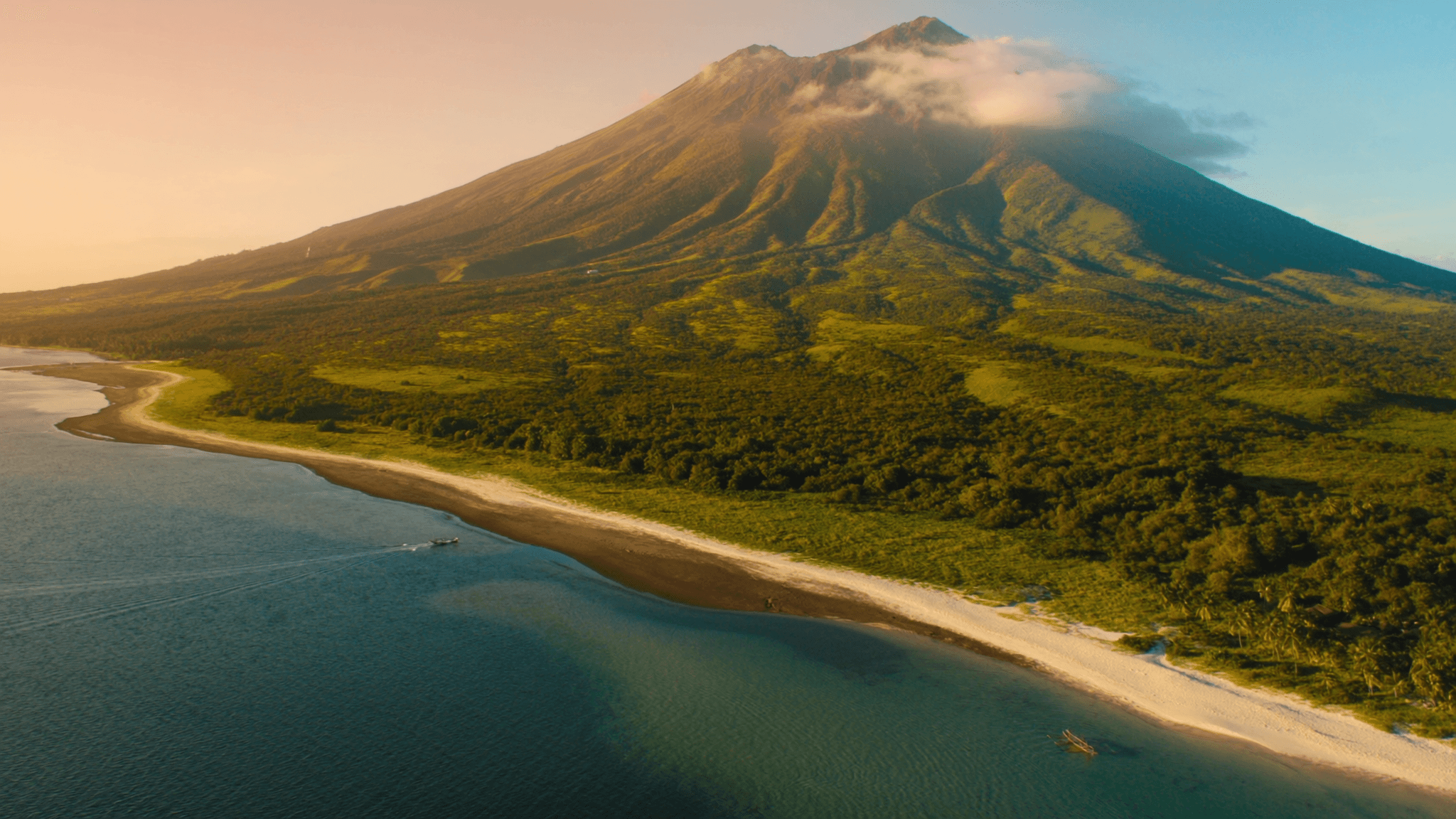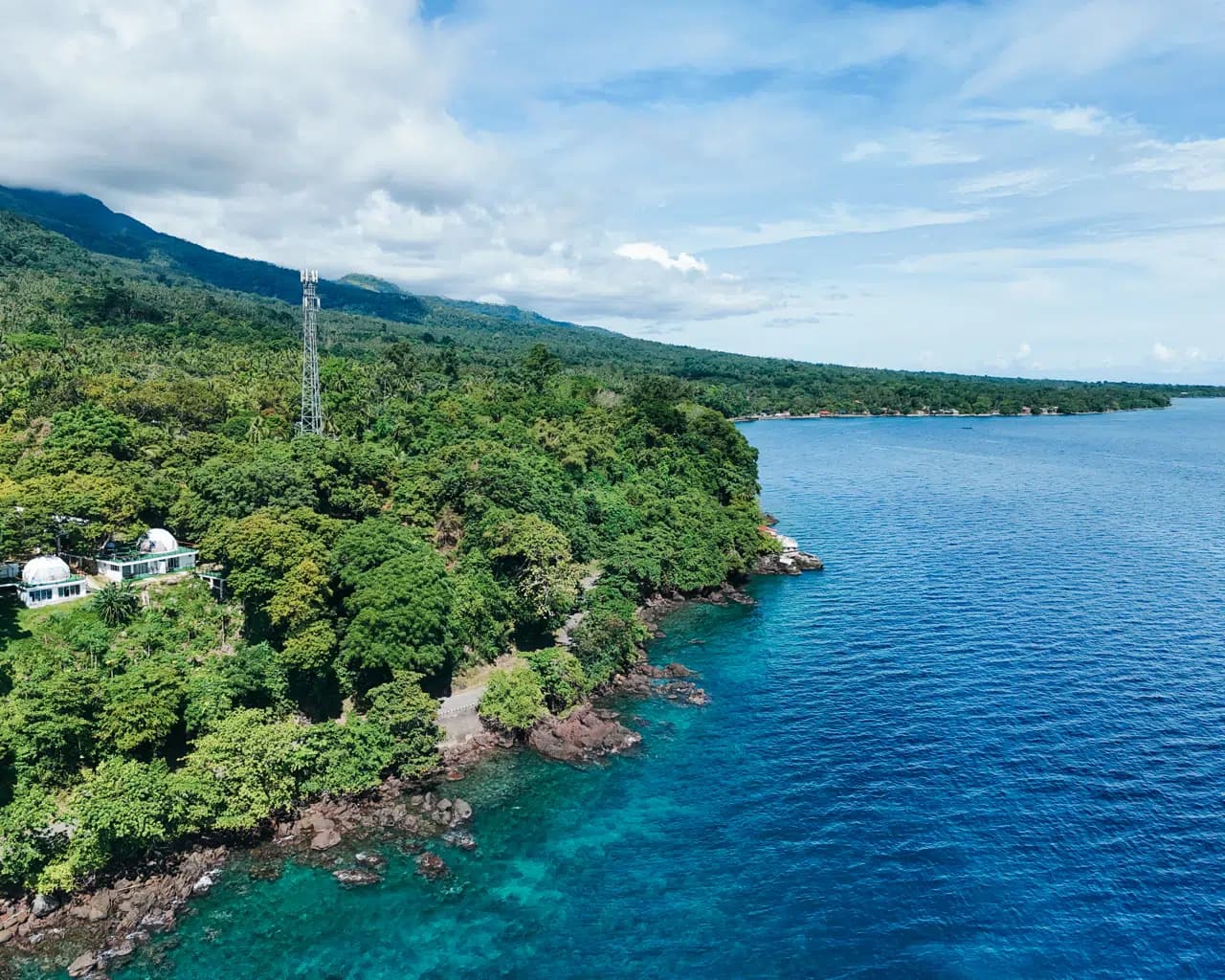
We live here. From our clifftop in Mambajao, with Mt. Hibok-Hibok at our backs and the Bohol Sea at our feet, the first sound most mornings isn't the surf — it's birdsong drifting down off the volcano's forest. Camiguin is a small island, but it carries something rare: a handful of birds that live here and nowhere else on Earth. Travellers ask us where to find them, and we'd rather give you the honest version than the hyped one. So this is our local guide to Camiguin birdwatching — what you can genuinely see, where, when, and with whom.
A gentle truth first: Camiguin is not a big-list destination. You won't tick five hundred species in a week. The draw here is quality — a tight clutch of island endemics in the forest above town, the kind of birds a serious birder crosses oceans for. We'll be straight about what's confirmed, what's still being argued over by scientists, and what we simply can't promise.
Written by the family at Txaleta de Camiguin. Last updated June 2026.
The birds found only on Camiguin
This is the real reason birders come. Camiguin has three full-species endemics — birds recognised as living on this single island and on no other patch of the planet. For an island you can drive around in an hour, that is extraordinary.
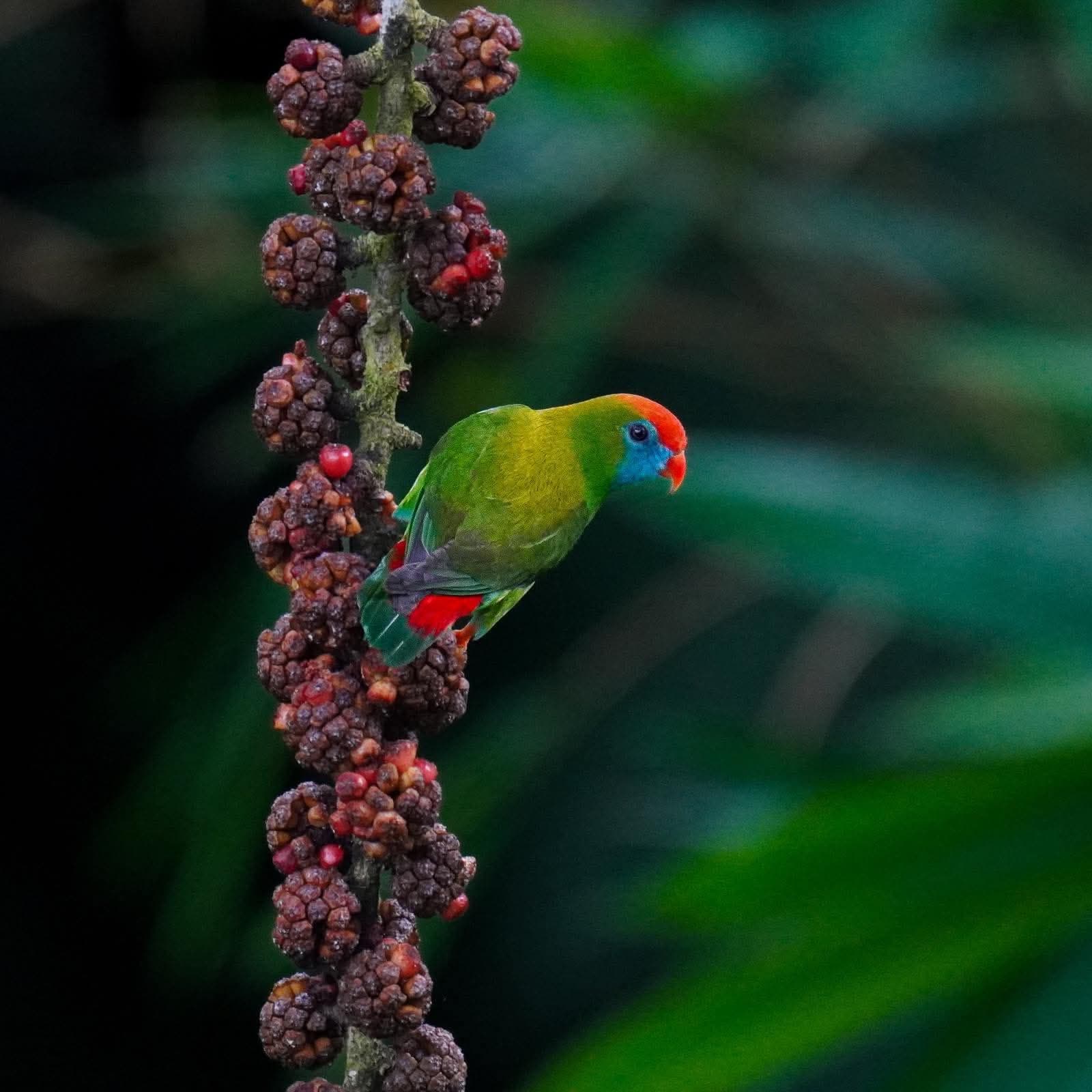
Camiguin Hanging-Parrot (Loriculus camiguinensis)
A tiny green parrot, described as a full species only in 2006 by researchers at the Field Museum — one of the most recently named birds in the Philippines. It is a genuine single-island endemic: it occurs only on Camiguin. You'll often hear it before you see it, a small fast shape crossing the canopy in lowland forest and forest edge.
We'll be honest about its status, because honesty matters more than flourish here. The IUCN Red List has not given it a standalone category — not because it's safe, but because the world's bird authorities haven't all agreed it's a separate species yet (some checklists still file it as a form of the wider Philippine Hanging-Parrot, pending DNA work). So the accurate phrasing is threatened and at risk — its population is small and declining, pressured chiefly by forest loss and the illegal cagebird trade — rather than a specific Red List rating it doesn't formally have. Please never buy or handle a caged "colasisi"; that trade is part of what threatens this bird.
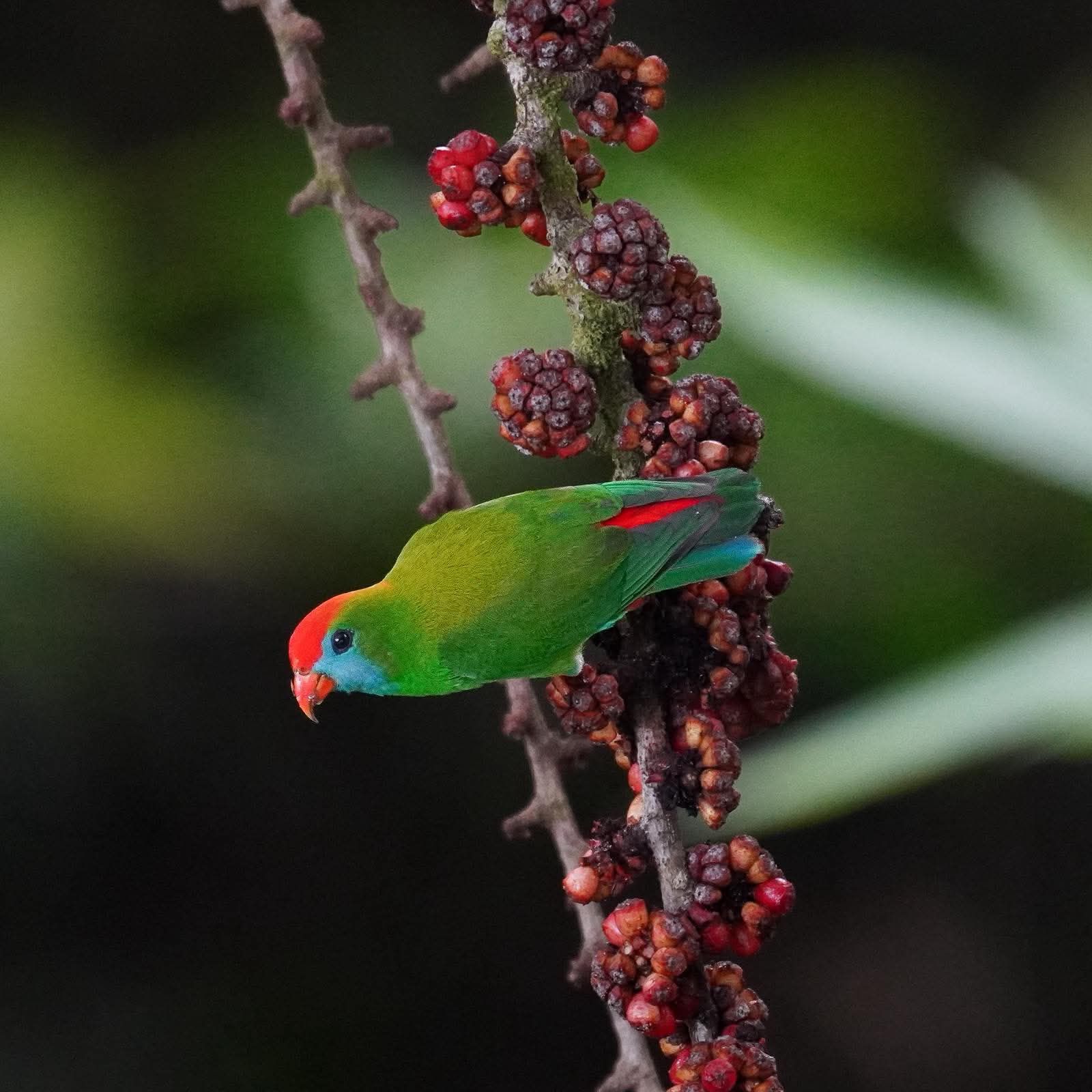 A Camiguin Hanging-Parrot in the forest canopy above Mambajao — a bird found only on this island.
Camiguin Boobook / Camiguin Hawk-Owl (Ninox leventisi)
The island's flagship owl, split off from the Philippine Hawk-Owl as a distinct species in 2012 on the strength of its voice. It is endemic to Camiguin alone. A bird of remnant broadleaf forest up to around 700 m, it's nocturnal and crepuscular — you find it after dark, by call, and lucky pairs will duet back at a patient guide.
On conservation status we'll flag genuine uncertainty rather than fake confidence. BirdLife/IUCN's citable standing assessment is Vulnerable (a tiny population, on the order of a few hundred mature birds), though several recent sources suggest it may have been uplisted to Endangered. We couldn't confirm that change at the primary source, so we'll call it Vulnerable, possibly recently uplisted — and encourage you to check the live IUCN Red List if you need the current category. Either way, it is a small population that deserves a quiet, respectful visit.
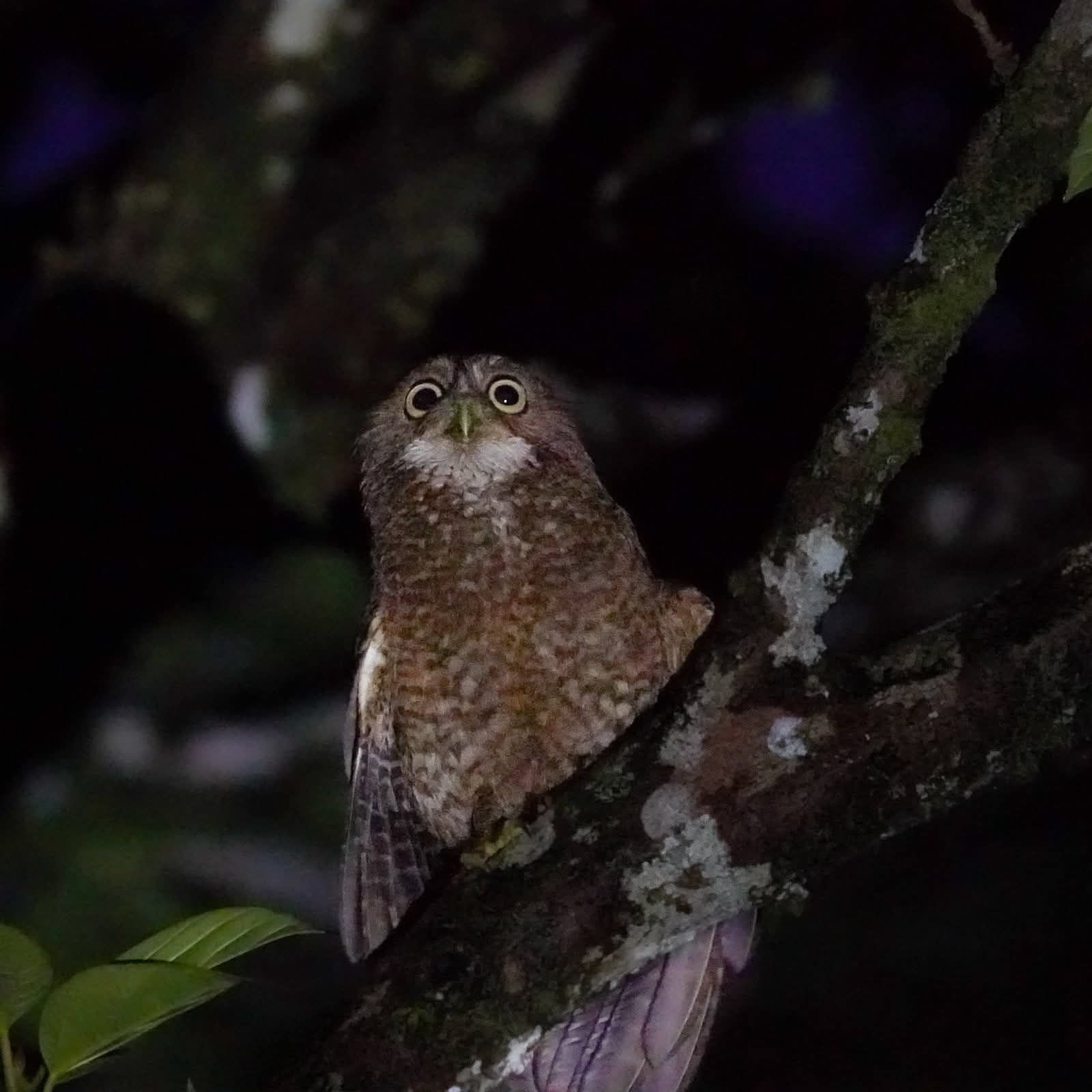 A forest owl photographed at night on Camiguin — owls here are found after dark by their call.
Camiguin Bulbul (Hypsipetes catarmanensis)
The endemic you're most likely to actually see. Split from the Yellowish Bulbul, it's a single-island endemic that moves in vocal little flocks through forest and second growth, and birders consistently report it as the easiest of the three to encounter. The IUCN lists it as Near Threatened — common where it occurs, but its whole world is this one small island, so the listing reflects that fragility.
A note on the science, in our "we'd rather say so" spirit: two of these three were elevated to full species fairly recently, and one (the hanging-parrot) is still debated. That doesn't make them less special — if anything it's why birders are paying attention now.
The near-endemics and forest specialities
Beyond the headline three, Camiguin holds several endemic island forms — distinctive local subspecies of more widespread birds. They're not full endemic species, and we want to phrase that carefully so we're not claiming more than the science does, but they're part of what makes the island's forest interesting:
- Camiguin (Yellowish) White-eye — Zosterops nigrorum catarmanensis, an endemic form of Camiguin Sur (this island, off Mindanao — not the unrelated Camiguin off Luzon). It favours good, higher-elevation forest, so short lowland visits sometimes miss it. Recent genetic work even suggests it may belong with the Mountain White-eye complex and could be reclassified in future — so we'll call its exact placement "under study."
- Black-naped Monarch (Camiguin form, Hypothymis azurea catarmanensis) — an endemic subspecies described from the island, darker blue than mainland birds, and reported as fairly uncommon. A nice interior catch.
- Dimorphic Dwarf Kingfisher (Ceyx margarethae) — a jewel of a bird, a Philippine endemic of the greater Mindanao region (IUCN Least Concern) that reaches Camiguin. It's frequently reported along forest streams here but is never guaranteed on a single visit — even visiting birders dip on it.
You may also encounter wider Philippine and resident species in the forest and along the coast — serpent-eagles soaring on the thermals, green pigeons in fruiting trees, a Brahminy Kite over the lagoons. The realistic island checklist runs to roughly 50-plus species — a number to set expectations honestly, not a single-day promise. One careful birder logged 47 species in a March visit; a brief survey logged fewer. Quality over quantity, always.
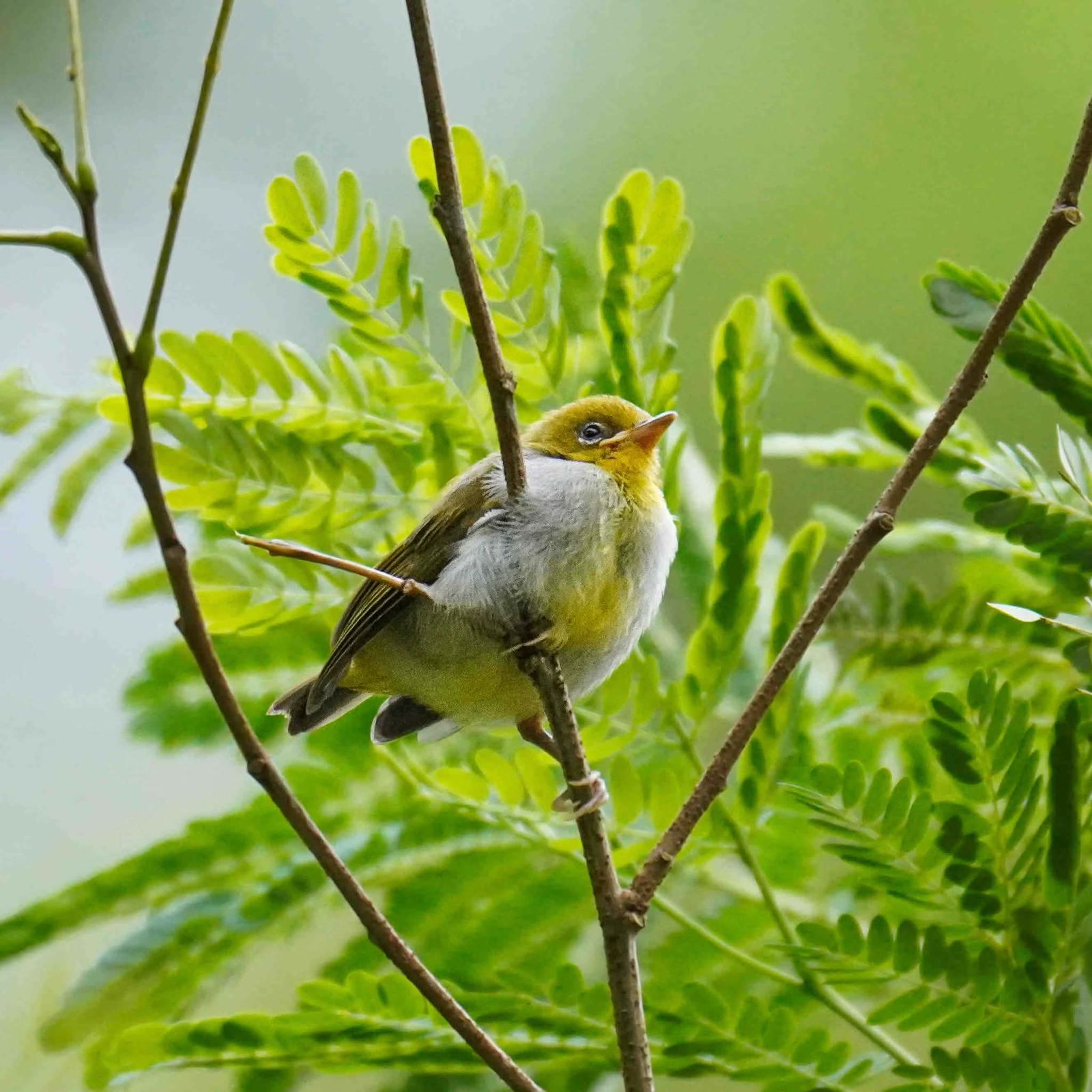 A Camiguin white-eye (Zosterops nigrorum catarmanensis) in the island's highland forest.
Where to go birdwatching in Camiguin
Almost all of Camiguin's endemic action happens in one place: the forest of the Mounts Timpoong–Hibok-Hibok Natural Monument (MTHNM) — a roughly 2,228-hectare protected forest declared an ASEAN Heritage Park in 2015, sitting between the lowlands and the volcano's summit (Hibok-Hibok rises to about 1,332 m).
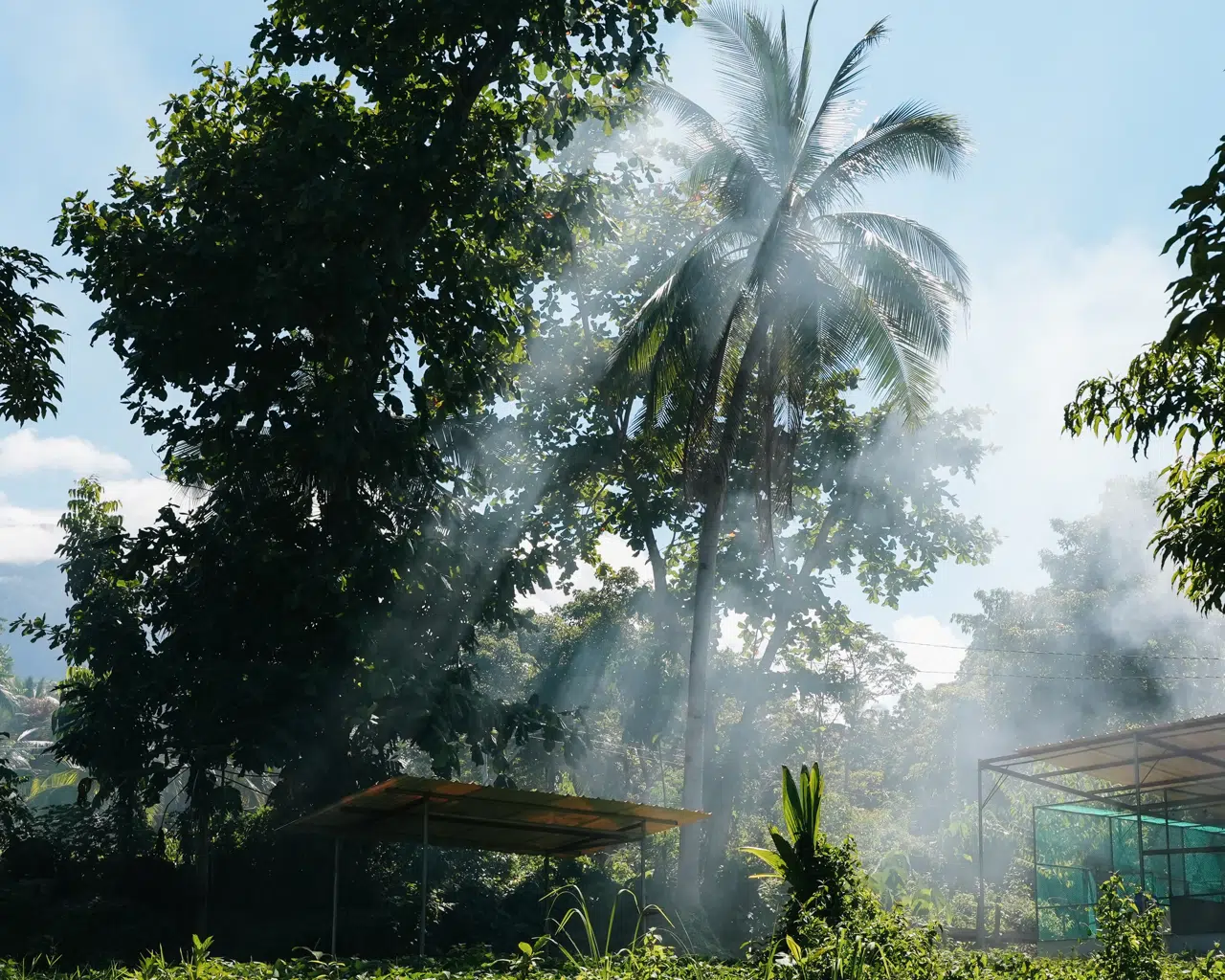 Rainforest on the slopes of Mt. Hibok-Hibok — the habitat that holds Camiguin's endemic birds.
| Spot | What it's good for | Effort |
|---|---|---|
| MTHNM Visitors Information Center, Sitio Itum, Brgy. Baylao, Mambajao | The staging point for organised birding; where the three endemics are looked for | Easy — this is the base |
| Itum forest-edge road (Brgy. Itum) | Birders' single most productive, easily walked spot — bulbul, hanging-parrot (often heard), paradise-flycatcher | Low; a gentle walk |
| Hibok-Hibok / Timpoong forest trails | The Camiguin Boobook's habitat; night/dusk owling by call | Moderate; guided |
| Hibok-Hibok summit trails (Itum / Yumbing) | Higher-elevation forms like the yellowish white-eye, in good forest near the top | Hard — a long, rope-assisted day |
| Katibawasan Falls, Mambajao | A listed eBird hotspot; cool shaded forest edge, low-effort | Easy |
| Taguines Lagoon, Mahinog | Open-country and water-edge birds — herons, egrets, Brahminy Kite | Easy |
| Mantigue Island Nature Park | A gentle forest-trail nature walk (marine sanctuary, not an endemic-bird site) | Easy; boat trip |
The honest headline: you do not need to climb the volcano to see the endemics. The forest near the Visitors Information Center and the Itum road deliver the headline birds without a summit push. The full Hibok-Hibok ascent is a wonderful day in its own right — a guided activity we love — but treat it as trekking that happens to pass good forest, not as the only way to bird. (If the summit is calling you, that's its own adventure — we've written it up honestly in our Mt. Hibok-Hibok trekking guide.)
One more honest note, because we won't oversell our own neighbour: Mantigue Island is a marine sanctuary, not an endemic-bird hotspot. Its draw is turtles, coral and a lovely short forest trail. Don't go to Mantigue expecting the hanging-parrot — go for the snorkelling and the trees, and route your endemic birding to Hibok-Hibok.
When to go: time of day matters more than the month
Here's where we part company with guides that invent a "peak season." We couldn't find a single reliable source naming a best month for Camiguin birding — and we won't pretend otherwise. The island's endemics are residents, present year-round, so birding works in any month.
What does matter is the time of day. The local MTHNM birding operation recommends:
- Sunrise to about 9:00 am — the forest birds are most active.
- 3:00 pm to sunset — the second active window.
- After dark — the only way to find the Camiguin Boobook, located by its call.
On the calendar, we'll offer general climate guidance rather than a false promise: the island's drier, calmer stretch tends to fall in the first half of the year, and most published Camiguin birding and photography trips land somewhere around February to April, while the wetter monsoon months (roughly November to January) can bring more rain. That's weather, not bird presence — the endemics don't migrate away. Always check conditions locally before you book, because mountain weather does what it likes.
Meet your guide: the people who know the calls
A field truth: these birds are small, skittish, and easily missed by a visitor walking alone. A local guide is the difference between hearing a hanging-parrot and seeing one — they know the regular trees, the calls, and the trails. And there's a deeper reason to go with them, one that sits at the heart of our community ethos: the guide fees and protected-area charges are direct support for the people and the forest that keep these birds alive.
Birding inside the MTHNM is organised through the Camiguin tourism / DENR system. You register first at the DENR-PENRO office near Mambajao Municipal Hall and go in with an accredited forest guide. Visitors have documented experienced local forest guards leading birders here — people who've spent years learning where the boobook duets after dark. Reported fees were around PHP 1,200 per group (up to three people) plus an environmental fee of about PHP 200 per person per day — but those numbers come from a 2022 write-up and prices change, so please confirm current rates with the tourism office when you book. The Hibok-Hibok summit trek likewise needs an accredited mountain guide.
Over on Mantigue Island, the short forest walk is led by a beloved local storyteller-guide known to everyone as Mang Ikoy. He's a character — funny, warm, and generous with the island's lore. He'll point out and name the islet's trees and, if you ask him, he'll tell you the story of how the island got its name. We won't spoil it here, partly because the story is his to tell and partly because, honestly, the written version of it isn't something we can verify — so go and hear it from the man himself. To set expectations kindly: Mang Ikoy is a nature and tree storyteller, not a bird specialist, so enjoy him for the forest walk and the company rather than a target-bird list.
If you'd like to reach out in advance, you can find a trusted local Camiguin guide on Facebook — though for the protected-area birding we're always glad to help arrange an accredited guide directly when you stay with us. (We feature our neighbours with their permission, and we'll only ever point you to a page a guide confirms is their own.)
What to bring, and how to bird kindly
Practical kit, no overselling:
- Binoculars — non-negotiable; the birds are small and quick. Photographers will want a telephoto of at least ~400 mm.
- A field guide or the eBird app to log and identify.
- Insect repellent, long trousers and high socks — there are small leeches on the lower trail sections.
- Sturdy, grippy footwear and light rain protection — forest trails are steep, sometimes rope-assisted, and often slick.
- An early start — see the time-of-day windows above.
And a word we feel strongly about. These are single-island populations — some of them live literally nowhere else on Earth. So please bird gently: use call playback sparingly if at all, keep your voice down, stay on the trails, and never buy or handle a wild-caught parrot. Camiguin's forest has already been through a lot — past logging stripped much of the lowland forest, and what remains is the whole world for these birds. Your guide fee and the protected-area charges are part of what protects it. Birding here is a small act of conservation when you do it right.
Pair your birding with the rest of Camiguin
Most guests don't come solely to bird — they come for the island, and the birds are a glorious bonus. A dawn session on the Itum road slots beautifully into a wider trip: White Island at sunrise, a waterfall in the heat of the day, a banca to Mantigue, a long slow merienda by the sea. If you're planning the shape of your days, our Camiguin itinerary lays out a three-day island plan you can fold a birding morning into, and if you're still deciding between islands, our honest take on Camiguin vs Siquijor may help — Camiguin's endemic birds are one thing its neighbour simply can't offer. For which weeks to come, see the best time to visit Camiguin; for where to base yourself, where to stay in Camiguin.
And the loveliest part of birding from here? The quiet forest edge near the cliff can be productive at first light, before you've even left for the mountain. You can wake to the sea at eye level, hear the forest stir, and be on the Itum road by sunrise.
Frequently Asked Questions
What birds can you see in Camiguin?
Camiguin's island checklist runs to roughly 50-plus species. The headliners are the three single-island endemics — the Camiguin Hanging-Parrot, the Camiguin Boobook (Camiguin Hawk-Owl), and the Camiguin Bulbul — alongside the Dimorphic Dwarf Kingfisher, a Black-naped Monarch island form, an endemic yellowish white-eye subspecies, and wider Philippine and coastal species like serpent-eagles, green pigeons and Brahminy Kites. Day lists are far smaller than the island total, so treat ~50 as the checklist, not a single-visit promise.
Does Camiguin have endemic birds found nowhere else?
Yes — three full-species endemics. The Camiguin Hanging-Parrot (Loriculus camiguinensis, described as a species in 2006), the Camiguin Boobook / Camiguin Hawk-Owl (Ninox leventisi, split as a species in 2012), and the Camiguin Bulbul (Hypsipetes catarmanensis). The island also has several endemic subspecies — local forms of more widespread birds — but the three above are the true endemic species.
Where is the best place to go birdwatching in Camiguin?
The forest around the Mounts Timpoong–Hibok-Hibok Natural Monument (MTHNM) Visitors Information Center in Sitio Itum, Barangay Baylao, Mambajao, is the main birding site, and the Itum forest-edge road is the most productive easy walk. Mantigue Island's short forest trail is a gentler nature walk, but it is a marine sanctuary rather than an endemic-bird spot.
What is the best time of day (and year) to see birds at Mt. Hibok-Hibok?
The best hours are sunrise to about 9:00 am and 3:00 pm to sunset, when forest birds are most active; the nocturnal Camiguin Boobook is found after dark by its call. We can't honestly name a single "best month" — birding is good year-round because the endemics are residents — but the drier, calmer weather tends to fall in the first half of the year (roughly February to April), with more rain in the November-to-January monsoon. Check conditions locally before booking.
Do I need a guide for birdwatching in Camiguin?
Yes, in practice. The birds are small and skittish, the forest trails need local knowledge, and the protected area requires it: you register at the DENR-PENRO office near Mambajao Municipal Hall and go in with an accredited forest guide. On Mantigue, the short forest trail is led by the storyteller-guide Mang Ikoy. We're glad to help arrange a guide when you stay with us — we'd rather not quote a fixed fee we can't guarantee is current.
Is the Camiguin Hanging-Parrot endangered?
It's an island endemic with a tiny, declining range and is genuinely threatened and at risk, mainly from forest loss and the illegal cagebird trade. But to be precise: as of our sources it had not been given a standalone IUCN Red List category, because the world's bird authorities don't all agree it's a separate species yet. So we say "threatened/at risk" rather than asserting a specific Red List rating it doesn't formally hold.
How hard is birding on Mt. Hibok-Hibok — do you have to climb the volcano?
No full summit climb is needed. Most endemic sightings happen in the forest near the Visitors Information Center and along the lower Itum road, not on the bare summit. Wear sturdy shoes for uneven, sometimes slippery trails. The full Hibok-Hibok ascent is a separate, longer guided trek — wonderful in its own right, but not a requirement for seeing the birds.
What should I bring for birdwatching in Camiguin?
Binoculars (essential — the birds are small and quick), a field guide or the eBird app, neutral quiet clothing, insect repellent, long trousers and high socks for the leech-prone lower trails, water, sturdy footwear, light rain protection, and an early start. Photographers should add a telephoto of around 400 mm or more.
Come home to Camiguin
If the idea of waking to birdsong off a volcano and being on a forest road by sunrise sounds like your kind of morning, come and let us set it up. We'll help you arrange an accredited local guide, point you to the Itum road and the MTHNM, and have a Spanish latte waiting for when you come down off the mountain. You can dip into the rest of the island too — White Island, the waterfalls, Mantigue with Mang Ikoy and his trees — and close each day with the sea at eye level.
Browse our rooms, see what else fills your days in our experiences, book your stay direct, or message us and tell us your dates — we live here, and we're happy to help you find these birds the right way. Reach us anytime at +63 917 582 2277, or visit us at Purok 6, Puting Balas, Mambajao, 9100 Camiguin.
Come for the views. Stay for the birdsong. Welcome home.
More Than a Resort. A Place to Belong. — Txaleta de Camiguin