
We run the glamping on this island, so take the enthusiasm with the appropriate amount of salt — and then read the section where we tell you who should not book it. That section is longer than the one selling it, deliberately.
This page does two jobs. The first is an honest account of what a night under canvas on a Camiguin clifftop is actually like — the heat, the sound of rain on a dome at two in the morning, the insects, the wind, the months it does not work, and the sort of traveller who will be quietly miserable in it. The second is a survey of the other five ways to sleep on this island that are not a hotel room, because glamping is one answer to "somewhere unusual" and it is not always the right one.
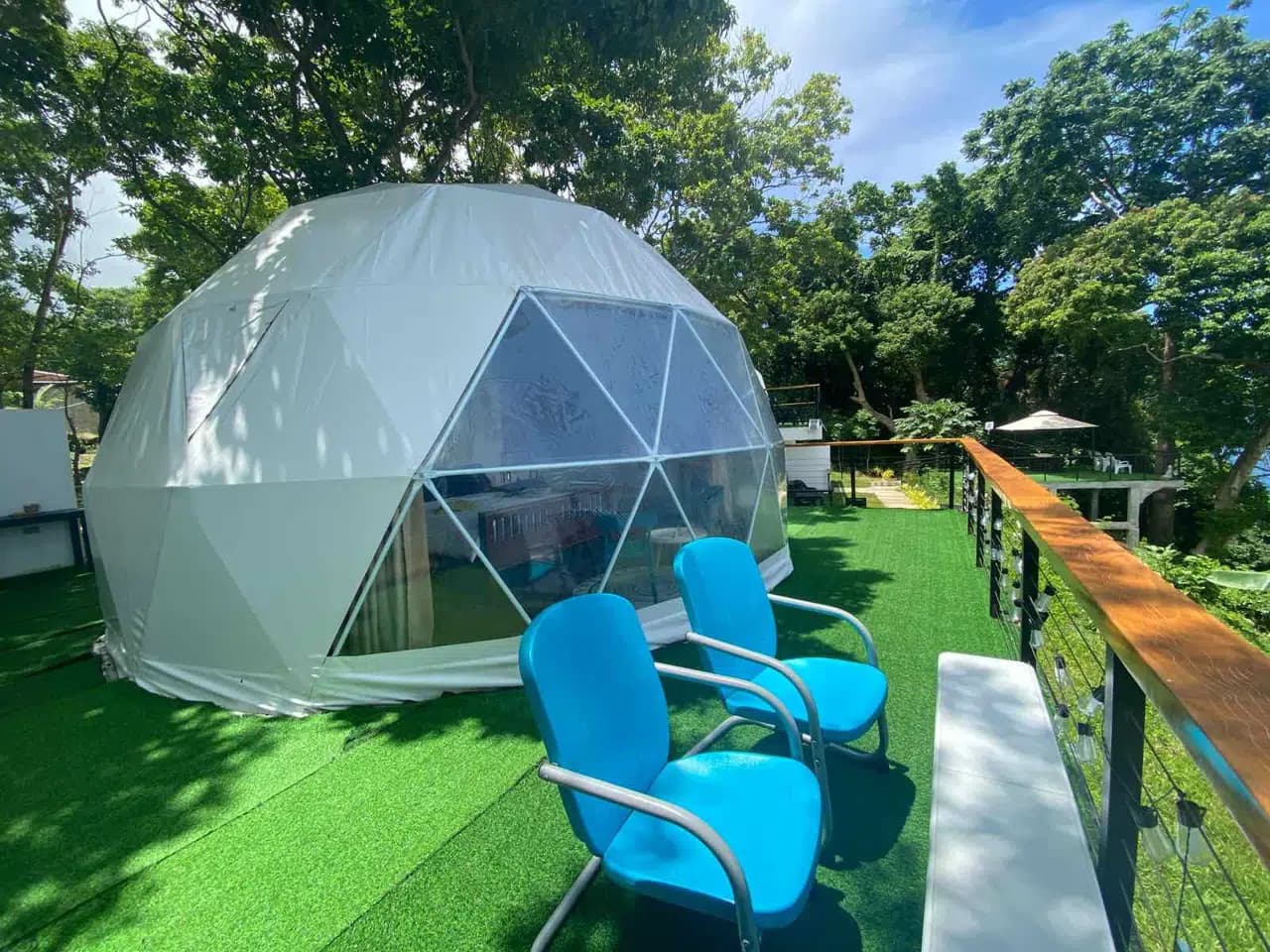
Quick answer: Glamping in Camiguin means a dome tent on the cliff edge — a proper queen bed, an en-suite rain shower, a private deck above the Bohol Sea, and no walls between you and the weather. The cliff faces east, so the sunrise comes into the tent over open water every morning of the year. There is no air conditioning, by design: the dome is cooled by sea air, which works beautifully from roughly November to May and is hard work in the still, hot weeks either side of it. The island's other unusual stays are homestays in Guinsiliban and Sagay, farmstays inland, dive lodges near Benoni, beach cottages on the north-west strip, and guesthouses in Mambajao town. If you want a unique place to stay and you also want a thermostat, book a room — we will say so again below.
Written by the family at Txaleta de Camiguin, on an east-facing clifftop above the Bohol Sea. Published November 2026.
What glamping actually is, and what it is not
The word has been stretched to cover a lot of things, several of which are just tents.
Glamping is camping with the discomfort engineered out and the exposure left in. That second half is the point and it is what people get wrong. You keep the bed, the bathroom, the lighting and the door that closes. You give up the thermal envelope — the insulated, sealed, climate-controlled box that a hotel room is.
So the honest test for any glamping listing anywhere is four questions:
- Is the bed a real bed? A frame and a proper mattress, not a camp cot or a futon on a platform.
- Is the bathroom en suite and plumbed? A shared block across a lawn at three in the morning is camping with better bedding.
- Is there power and light that does not involve a torch?
- What climate control is there, honestly stated? This is the one that is most often fudged.
Our domes answer: yes, yes, yes, and none — it is sea air through the dome, and that is the deal. We would rather lose the booking than have you find out at eleven at night.
Why a dome, and not a tent
Nobody asks this and it is the most interesting thing about the structure, so here it is.
A dome is a sphere cut off at the floor, and a sphere encloses the most space for the least skin. Every consequence below follows from that one fact.
Wind. A ridge tent presents a flat side to the weather, and a flat side is a sail. A dome has no flat anywhere — wind divides around it and the load spreads through the whole frame instead of concentrating on two poles and a guy line. On an exposed cliff, which is where you want to be for the view and the worst place to be in a blow, that is not a design flourish. It is the reason the thing can be there at all.
Usable floor. In a ridge tent you can only stand along the spine; the walls fall away and the edges of the floor are good for luggage. A dome holds its height much closer to the perimeter, so a bed does not have to sit in the middle and the floor area on the plan is roughly the floor area you can use.
Air. Warm air collects at the apex, which on a dome is a single high point rather than a long ridge, so venting at the top moves the whole volume. This matters more than it sounds in the tropics, and it is the reason the next section is a refusal rather than an apology.
And the sky. This is the part people actually book it for. Lying flat on your back in a ridge tent you are looking at fabric a metre from your face. In a dome you are looking at the apex, which means the overhead surface is the thing above you rather than beside you — and when that surface is clear, you are in the sky rather than looking out at it.
The test, if you are booking glamping anywhere: ask what shape the structure is and how it is anchored. "Dome" and "safari tent" and "bell tent" are three genuinely different products with three different relationships to weather, and the listing will usually tell you only the word.
Why Camiguin has almost no glamping
Camiguin is a small island — 238 square kilometres, around ninety thousand people — and its accommodation grew up as family-run beach resorts along one stretch of the north-west coast. That is a sensible thing to build and it is what the market asked for.
Glamping needs something that stretch mostly does not have: a piece of ground with a view worth sleeping outdoors for, far enough from a road to be quiet, and flat enough to put a platform on. On a volcanic island, that combination is rare. The cliffs are where it exists, and the cliffs are scarce — we go into why, and how to judge one, in our guide to Camiguin's clifftop resorts.
The practical consequence for you is that "glamping in Camiguin" is a very short list, which is lovely for us and worth being suspicious about. A short list is not the same as a good product. Hence the tests above, and the honest section below.
The six unusual places to sleep on Camiguin
Glamping is one row in this table. If you came here searching for somewhere that is not a hotel room, the other five deserve a fair hearing, and some of them will suit you better.
| The stay | Where | What it gives you | The catch |
|---|---|---|---|
| Glamping dome | The eastern cliffs | Sunrise over open water from the bed; no walls | No air conditioning; weather-dependent |
| Homestay | Guinsiliban, Sagay, the south | The island as people actually live it, at the lowest cost on it | Very simple; you need your own wheels |
| Farmstay | Inland, the volcano's skirts | Cool nights, fruit trees, genuine quiet | Far from the sea and from dinner |
| Dive lodge | Benoni / Mahinog, the east | Tanks, boats and like-minded company | Functional rooms; the sea is the point |
| Beach cottage | Agoho, Yumbing, Bug-ong | Step out of the door onto dark volcanic sand | The island's busiest stretch |
| Town guesthouse | Mambajao Poblacion | Market, bakeries, ATMs and tricycles at the door | A town, not a view |
Two notes on that table. Homestays and farmstays are the cheapest beds on Camiguin by a wide margin and the ones guests talk about longest afterwards; if your budget is tight, do not read "unusual" as "expensive". And the south of the island, around Guinsiliban and Sagay, is the quietest quarter of an already quiet place — we cover the whole geography in where to stay in Camiguin.
A night in a dome, hour by hour
This is the part we can describe first-hand.
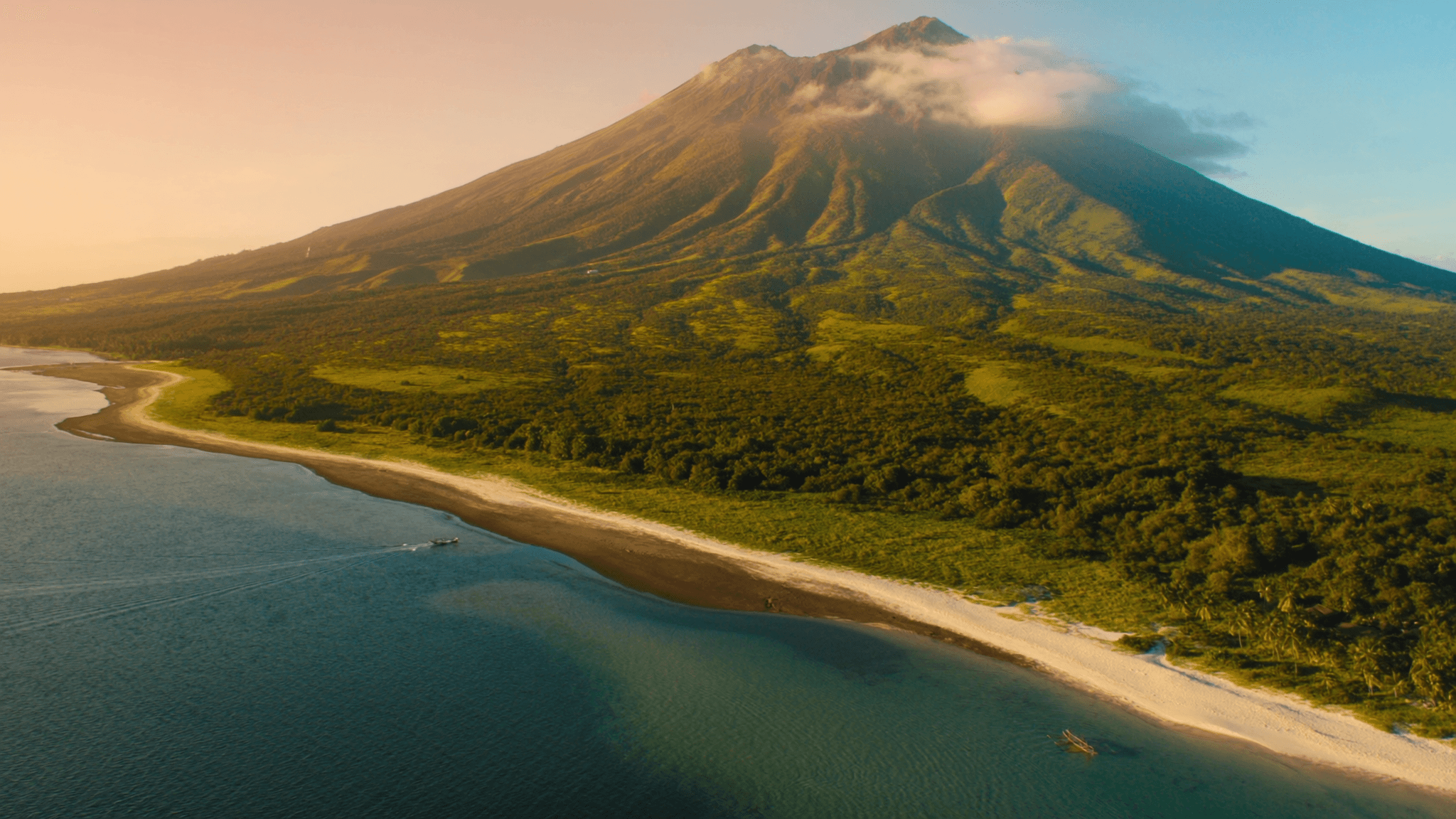
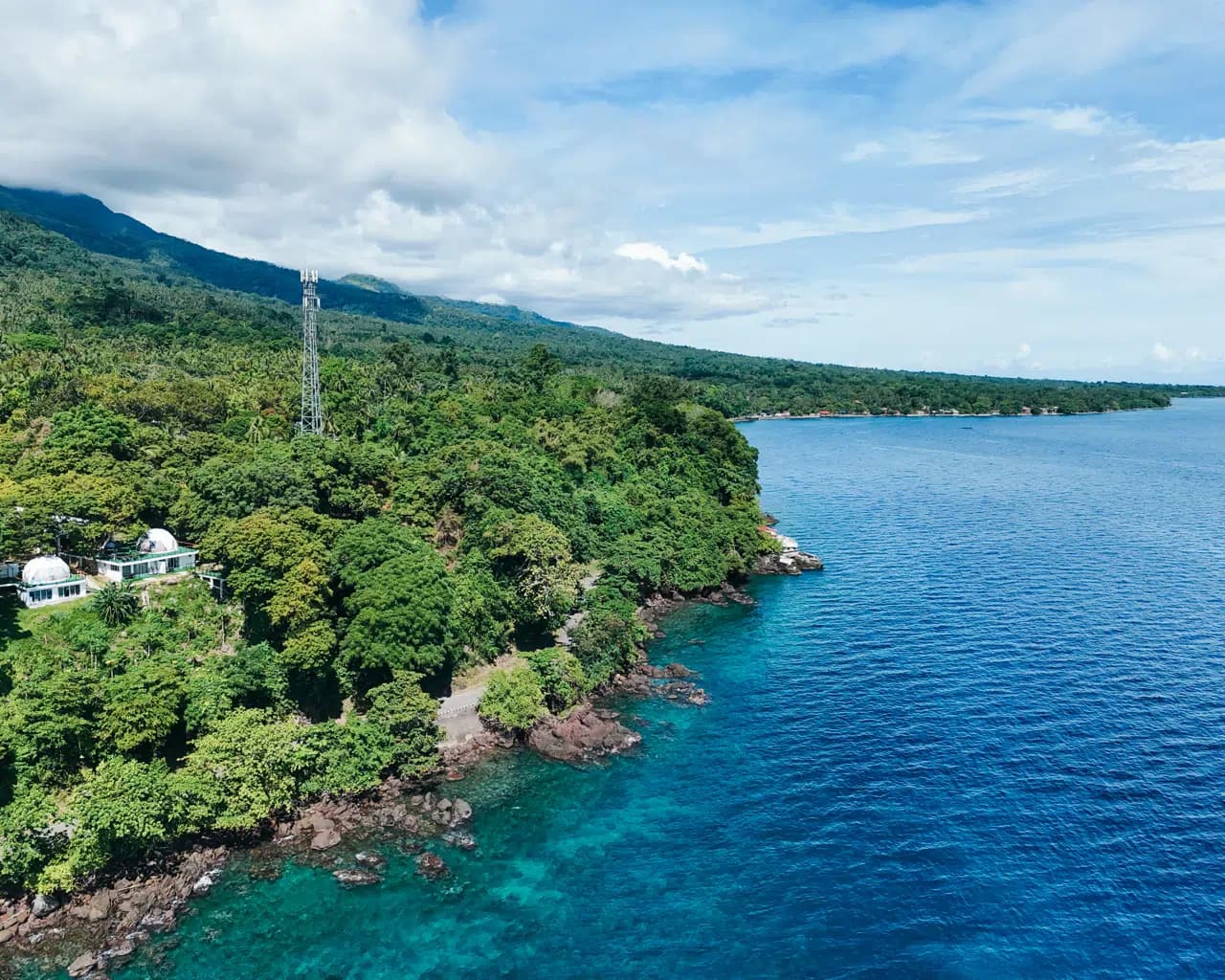
Late afternoon. You arrive at the deck and the first thing most people do is stop talking. The dome sits at the cliff edge forty metres above the Bohol Sea, facing open water, which puts the horizon about twenty-two kilometres out — roughly five times what you see standing on a beach. There is nothing in the frame but sea, the low green dot of Mantigue Island to the south-east, and the mountains of mainland Mindanao along the southern horizon in clear weather. We work through why that height changes the view, and not just its distance, in the clifftop guide.
Six o'clock. This is the hour we lose and we may as well say it here. We face east, so the sun does not set in front of you — it goes down behind the island. What happens instead is that the sea below turns from blue to pewter, the sky over the water goes rose, and Mt. Hibok-Hibok catches the last gold behind the tent. If a sun dropping into the water from your own deck is the specific picture in your head, that is the north-west coast, and our sunset guide will tell you exactly where to stand for it.
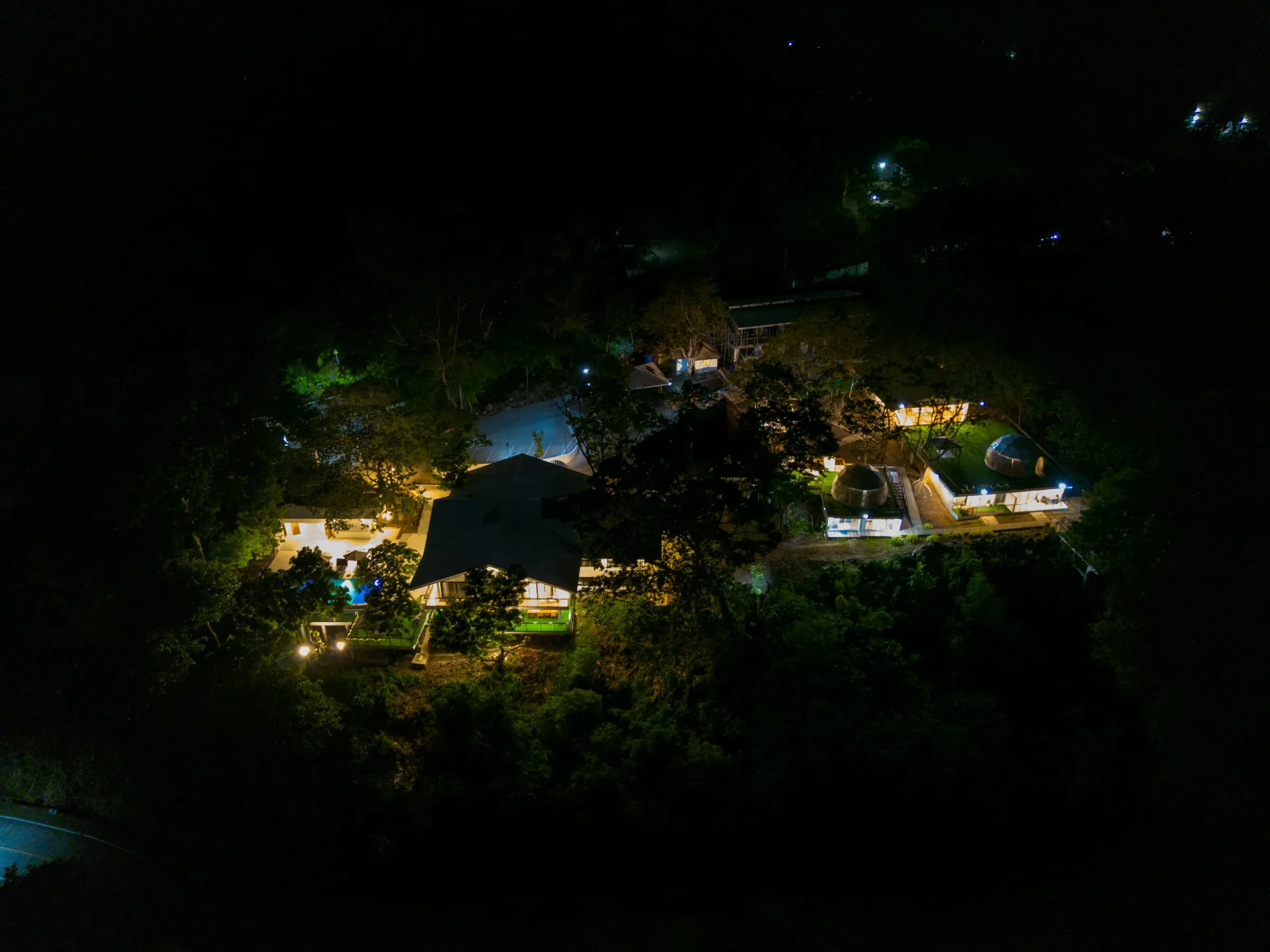
After dark. Camiguin has very little light pollution. On a clear night the sky from the deck is genuinely remarkable, and lying on a bed looking up through a dome at it is the single thing guests describe most often afterwards. Bring something warm for your shoulders; it is not cold, but the sea breeze after midnight is cooler than you expect.
Two in the morning, if it rains. Rain on canvas is loud. Some people find it the best sleep of the trip. Some people do not sleep. We cannot tell you in advance which you are, and it is worth thinking about honestly before you book, particularly between June and October.
Half past five. The reason the dome exists. The sunrise point here swings only between about 66° and 114° across the whole year, and every degree of it is open water, so there is no month when the sun comes up behind land. The light arrives through the canvas and into the tent, and you do not have to go anywhere, set an alarm for a boat, or hope.
Breakfast. Served over the water. The restaurant is open from eight, and takes walk-ins as well as guests.
The one thing we refuse to add, and why
There is no air conditioning in the domes, we are not going to install any, and that is a decision rather than a shortfall.
The straightforward version: you cannot air-condition a tent. You can only do one of two things to it. You can insulate and seal it, at which point it has stopped being a tent and has become a small room with canvas wallpaper — and everything you came for, the air, the sound of the sea, the weather happening a few feet away, is on the wrong side of the envelope. Or you can fit a unit that fights the outside air continuously, which roars, which is why you would be paying extra to stop hearing the thing you booked.
So the dome is cooled the way a dome on a cliff is supposed to be cooled: the sea breeze, which on this edge runs most of the day and nearly every night. The siting is the climate control. It is also the reason the domes are where they are rather than in a nicer spot further back from the drop.
And there are nights it is not enough. In the still, humid weeks — typically the end of the dry season running into the first rains, with afternoons at 31–32 °C — the air stops moving and a canvas room gets warm and stays warm. That is not a rare event and we are not going to pretend it away. It is the single most common reason a guest would be happier in a room, and the reason we ask.
If a thermostat is part of what you mean by comfortable, book a room. You will have a better week, the view from it is identical, and we would rather have that conversation now than at eleven o'clock at night.
The honest bit
Every section above is the case for it. This is the case against, and it is the reason this page exists.
There is no air conditioning. The dome is cooled by moving sea air, which on a cliff is usually plenty. In the still, humid weeks — typically the end of the dry season into the first rains, when afternoons run 31–32 °C — it is warm at night and some guests find it too warm. If you sleep badly in heat, book a room with a thermostat. You will enjoy the holiday more and we would rather you did.
Rain is loud, and the wet season is real. Camiguin's heavier rain runs roughly June to November, with the north-east amihan bringing its own wet, windy spell around December to February. Our guide to the best time to visit breaks the year down properly. A dome in a downpour is dry and it is not quiet.
Wind. An exposed cliff gets weather before anywhere else does. Most nights that is the best feature of the place. On a rough night it is not, and if a storm is forecast we will move you into a room — which is the right call and also means the thing you booked is weather-dependent in a way a hotel room is not.
Insects exist on tropical islands. The dome closes properly and the bed is protected, but you are sleeping outdoors in the Philippines and there will be insect life on the deck at dusk. Bring repellent, as you would anywhere here; our practical tips guide has the rest of the small print.
It is two people, and it is not for small children. The dome sleeps two, and a cliff-edge deck with a toddler is a holiday spent watching rather than resting. We say the same about the cliff generally in Camiguin with kids.
And it is not a cheap bed. Glamping is not budget accommodation here or anywhere. If what you want is an unusual, inexpensive night on Camiguin, a homestay in the south will give you a better story and cost a fraction.
How to actually sleep in a dome
Most of this transfers to glamping anywhere warm, and nobody tells you any of it.
Open it up before dark, not when you get hot. Canvas holds the afternoon's heat and a dome that was closed all day starts the night warm. Get the air moving through it while the sun is still up and you are working with the structure instead of against it.
Lie with your head toward the opening, not away from it. Moving air over your head and shoulders is what does the work; air over your feet does almost nothing. It is a small adjustment and it is the difference between a warm night and an uncomfortable one.
Expect to wake at about four. The breeze usually freshens before dawn and the temperature drops more than you think it will. This is why a light layer matters far more here than a thicker blanket — you want something you can pull over your shoulders at four and push off at six.
Decide the night before whether you want the sunrise. If you do, leave the opening clear and do not bring an eye mask; the light will handle the alarm. If you do not, bring one, because the light arrives at around half past five and it is not subtle.
Do your packing before dark. Finding a charger by torchlight on a cliff deck is an avoidable category of problem.
And accept the first night is the worst one. Almost everybody sleeps lightly the first night under canvas and properly the second, which is one more argument for two nights in the dome rather than one.
Glamping or a room? The comparison that sometimes costs us the booking
Guests ask us this constantly, usually a week before arrival, and the answer is genuinely not always the dome.
| Glamping dome | Seaview room or suite | |
|---|---|---|
| The view | Identical — same cliff, same horizon | Identical |
| Sunrise | Comes into the tent | Comes through the glass |
| Climate | Sea air only | Air conditioning |
| Rain | Audible | Not |
| Night sky | You are in it | Through a window |
| Sleeps | Two | Two to a family, depending on the room |
| Best months | Roughly November to May | Any |
The honest summary: the view is the same from both. What the dome adds is exposure — the sky, the air, the sound of the sea and the rain. What it removes is the thermostat and the soundproofing.
So: one or two nights in the dome and the rest in a room is the arrangement we suggest most often, and the one that produces the fewest regrets. You get the night under the stars while it is still a novelty, and you get a cool, quiet room for the nights after a long day on the ring road. Both are on the booking page, and we will happily split a stay across the two.
What is provided, and what to bring
Provided: a queen bed with proper linen, an en-suite rain shower, power and lighting, WiFi, the private deck, and breakfast.
Bring: insect repellent, a light layer for after midnight, an eye mask if you are the sort of person who wakes at first light and does not want to (the whole point of the tent is that you will), and a torch for moving around the property after dark — the ring road and most island grounds are unlit, which our getting-around guide treats as a genuine planning fact rather than a detail.
Do not bother bringing: a sleeping bag, a mat, or anything else from a camping list. This is not camping and you will carry it for nothing.
When to book it
November to May is the dome's season, and the heart of it is roughly February to May, when the rain is least likely and the nights are moving air rather than still heat. April is statistically the driest month of the year on Camiguin and also the hottest, which is the trade.
June to October is the green season. It does not rain all day, the island is at its most beautiful, and the rates across the island are at their kindest — but a dome in that window is a gamble on your own tolerance for weather at night, and you should book it knowing that.
Avoid Lanzones Festival week in October if you want quiet; the island is wonderful then and it is not quiet. We cover it in the festival guide.
Who it is for
Book the dome if: you are a couple, you sleep well in warm air, you would rather hear weather than be sealed off from it, you get up early or would like an excuse to, and the phrase "nothing between us and the sea" sounds like a feature rather than a worry.
Book a room instead if: you need air conditioning to sleep, you are travelling with small children, you are a light sleeper, you are coming in the heaviest part of the wet season, or your idea of a holiday involves a dark room at two in the afternoon.
And book a homestay instead if what you actually want is the island itself, told to you by somebody who lives on it, for a fraction of any of the above. That is not a consolation prize. It is frequently the better trip.
Frequently asked questions
Is there glamping in Camiguin?
Yes, though very little of it. The island's accommodation grew up as family-run beach resorts along the north-west coast, and glamping needs something that stretch mostly lacks: ground with a view worth sleeping outdoors for, quiet, and flat enough for a platform. On a volcanic island that combination is found on the cliffs, which are scarce. Our dome tents sit on the eastern cliffs at Puting Balas, in Mambajao.
What is a glamping dome tent like to sleep in?
A proper queen bed with real linen, an en-suite rain shower, power, lighting and WiFi, on a private deck at the cliff edge. What you give up is the sealed, climate-controlled box that a hotel room is: there is no air conditioning, the dome is cooled by sea air, and rain on canvas is loud. Most guests describe the night sky through the dome as the thing they remember longest.
Why are glamping tents dome-shaped?
Because a dome is a sphere cut off at the floor, and that single fact decides everything else. Wind divides around it instead of striking a flat side, and the load spreads through the whole frame rather than two poles and a guy line, which is what makes an exposed cliff possible at all. It holds its height close to the perimeter, so the floor area on the plan is roughly the floor area you can use. Warm air gathers at one apex, so venting the top moves the whole volume. And lying on your back you are looking at that apex, which is why the sky is above you rather than through a door.
Does glamping in Camiguin have air conditioning?
Ours does not, and that is by design rather than omission — the domes are cooled by moving sea air, which on an exposed cliff is usually ample. In the still, humid weeks it is warm at night. If you sleep badly in heat, book a room with a thermostat instead; it is a better holiday and we would rather say so before you arrive.
Can you see the sunrise from a glamping tent in Camiguin?
From an east-facing cliff, yes, every morning of the year. The sunrise point at this latitude swings only between about 66 and 114 degrees along the horizon, and from that coast all of it is open sea, so there is no month when the sun comes up behind land. The light arrives through the canvas at around half past five.
What happens if it rains while you are glamping?
The dome stays dry; it is simply loud. Some guests say it is the best sleep of the trip and some do not sleep at all, and we cannot tell you in advance which you will be. If a storm is forecast we move guests into a room, which is the right call and also means a dome is weather-dependent in a way an ordinary room is not.
What is the best month for glamping in Camiguin?
Roughly November to May, with February to May the strongest stretch: least rain and moving night air rather than still heat. April is statistically the driest month and also the hottest. June to October is the green season, which is beautiful and kind on rates but is a gamble on your own tolerance for weather at night.
Is glamping in Camiguin suitable for children?
Our domes sleep two and sit on a cliff edge, so no — a clifftop deck with a small child is a holiday spent supervising rather than resting. Families are generally happier in a room a few steps back from the edge, with a pool and shade, and the island as a whole is excellent for children once you are not sleeping on a precipice.
What should you pack for glamping in the Philippines?
Insect repellent, a light layer for after midnight, an eye mask if you do not want to wake at first light, and a torch, since island grounds and the ring road are unlit. Do not bring a sleeping bag, mat or anything else from a camping list: glamping provides the bed and the bathroom, and you will carry the rest for nothing.
What are the most unique places to stay in Camiguin?
Six things that are not hotel rooms: glamping domes on the eastern cliffs, homestays in the quiet south around Guinsiliban and Sagay, inland farmstays on the volcano's skirts, dive lodges near Benoni and Mahinog, beach cottages on the north-west strip, and guesthouses in Mambajao town. The homestays and farmstays are the cheapest beds on the island and often the ones guests talk about longest.
Is glamping expensive in Camiguin?
It is not budget accommodation, here or anywhere — a dome costs more than a simple room because of what it sits on rather than what it contains. If what you want is an unusual and inexpensive night on Camiguin, a homestay in the south will give you a better story for a fraction of the price, and we would point you there without hesitation.
Can you book one night of glamping and the rest in a room?
Yes, and it is what we suggest most often. The view is identical from both; the dome adds exposure to the sky and the air, and removes the thermostat and the soundproofing. One or two nights under canvas while it is still a novelty, then a cool quiet room for the nights after a long day on the ring road, is the arrangement that produces the fewest regrets.
Do you need a vehicle if you stay on Camiguin's eastern cliffs?
It helps considerably. You are about seven kilometres from Mambajao town and its restaurants, five from Benoni ferry port and roughly six and a half from Mantigue Island, so the south-east is close and the north-west strip is a drive. There is no ride-hailing anywhere on the island and public multicabs stop in the early evening, so either rent wheels, use a driver, or stay somewhere that will run you around.
Come home to Camiguin
A dome on a cliff is a narrow product. It suits a particular traveller in particular months, and we have spent most of this page explaining who that is not, because the alternative is a guest lying awake at midnight wishing they had booked a room.
If it is you, there is nothing else quite like it on this island: open sea, no walls, the Milky Way overhead, and the sun coming up over the water at half past five without you having to go anywhere at all.
See the dome and the rooms, book direct, or just message us on WhatsApp and ask us straight whether it suits you — we will tell you if it does not. Reach us anytime at +63 917 582 2277, or come and find us at Purok 6, Puting Balas, Mambajao, 9100 Camiguin.
Bring repellent. Welcome home.