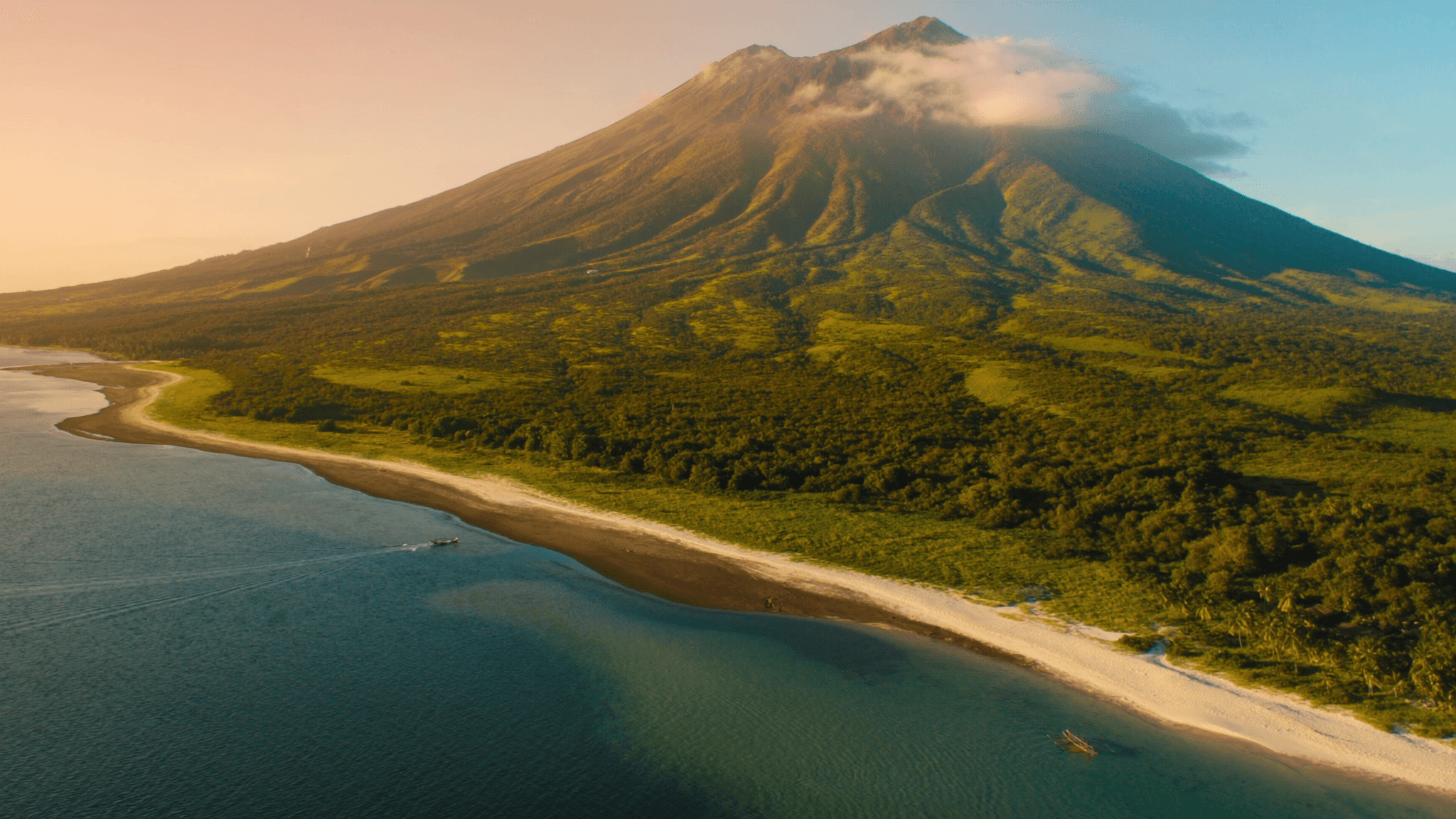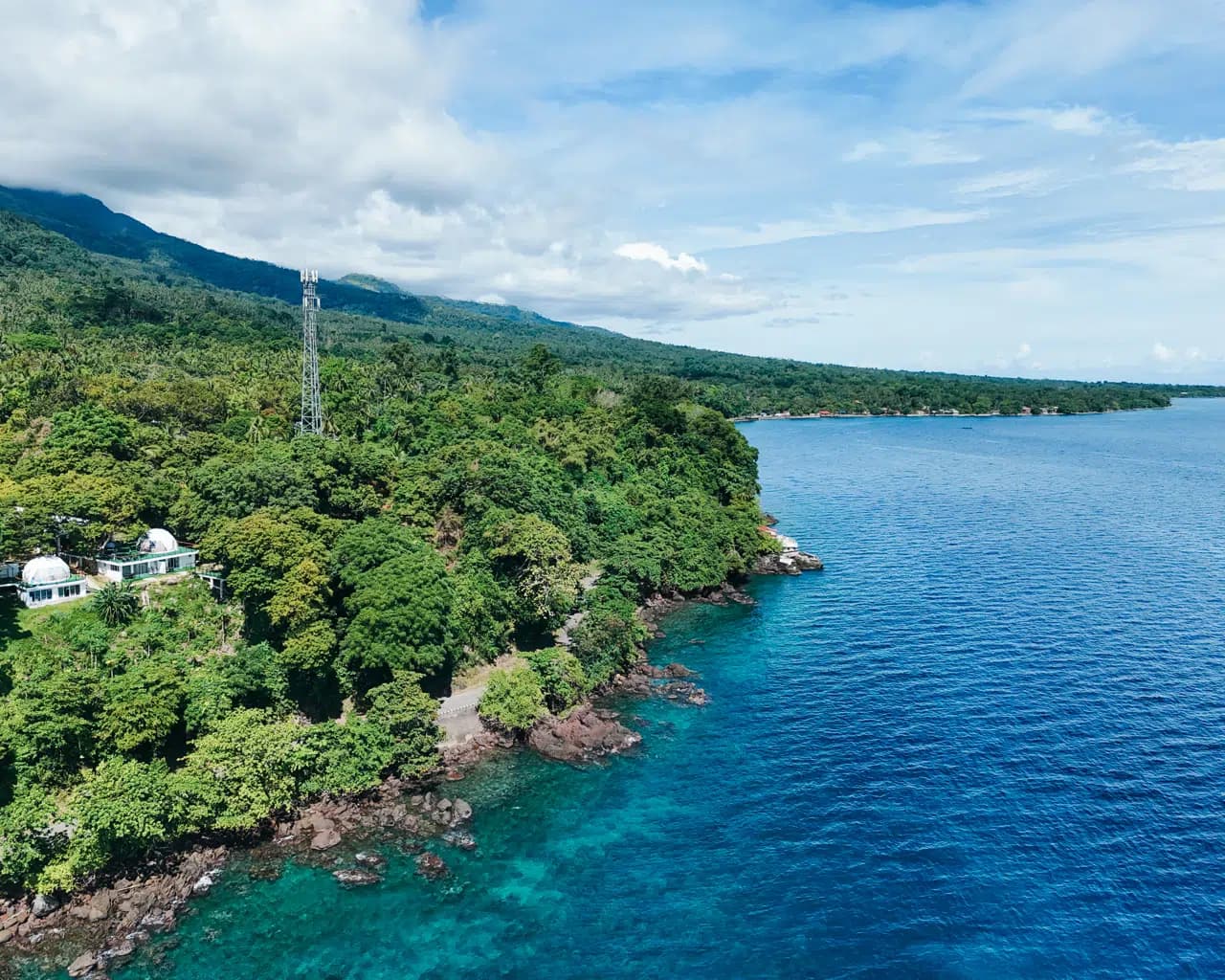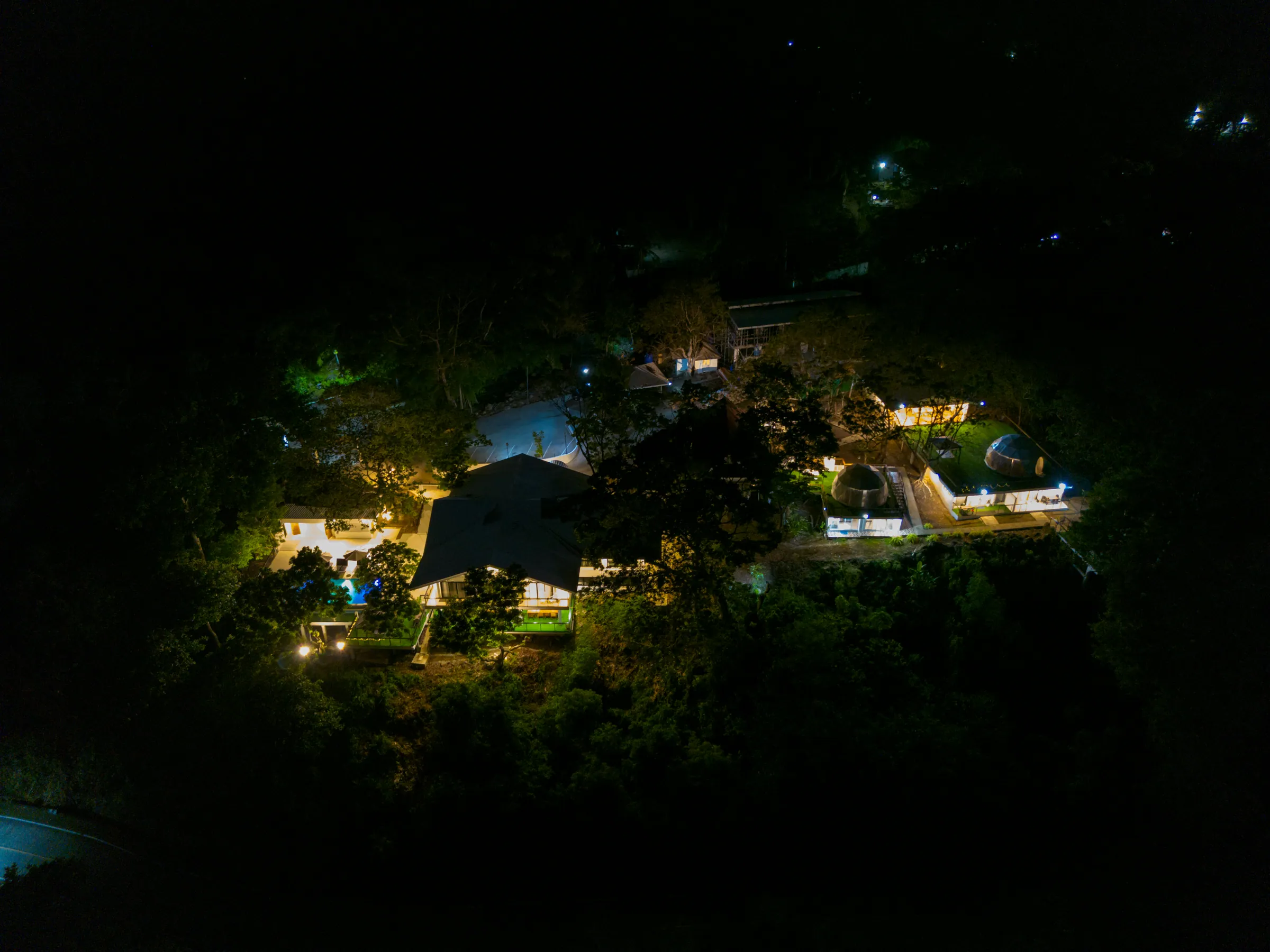

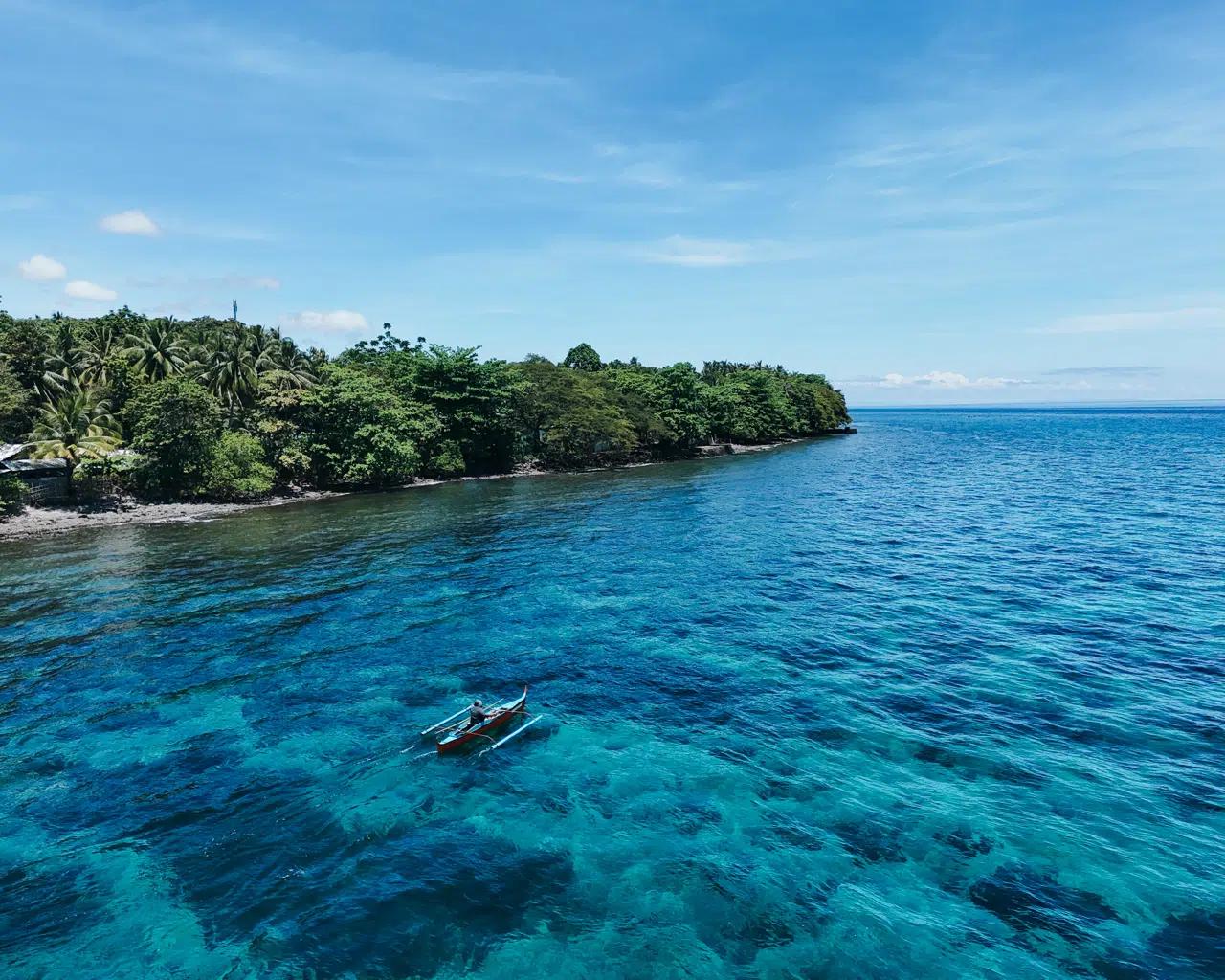
We are Txaleta de Camiguin, a small resort on the island's east-facing cliffs, and we watch guests unpack every week — which is how we know the usual Philippine beach list is wrong for this island. It was written for white-sand strips you walk out onto. Camiguin is a young volcano with a coastline of dark sand and rock, a sandbar with no shade, a mountain that is cold at the top, springs you sit in after dark, and a flight with a cabin allowance smaller than most people's toiletry bag.
So this is the list for this island, written from it. It is shorter than you expect in some places, longer in others, and it starts with your feet.
Quick answer: Pack for rock and black sand, not powder beaches: one pair of water shoes with a real sole, sandals with a back strap, and trail shoes if you are climbing Hibok-Hibok. Bring a long-sleeved rash guard — it does more than sunscreen on a sandbar with no shade — plus reef-safe sunscreen, a hat, insect repellent, a dry bag for the bancas and a power bank. From June, add a light rain shell or poncho; from November to January, a second pair of shoes and a layer for the boat. Carry cash in small notes and any prescription medicine for the whole trip. And if you fly Cebu to Camiguin, the plane is a Cebgo turboprop with a 7 kg cabin allowance — pack to that, or pay for a checked bag in advance.
Written by the family at Txaleta de Camiguin, on an east-facing clifftop above the Bohol Sea. Published November 2026.
The Camiguin packing list at a glance
Screenshot this one. Everything after it is the reasoning.
| Category | Pack | Why it matters here |
|---|---|---|
| Feet | Water shoes; strapped sandals; trail shoes if climbing | Rock shores, hot black sand, slick spring and waterfall steps |
| Sun | Long-sleeved rash guard, wide hat, reef-safe sunscreen, sunglasses | No shade on White Island; UV at its strongest from about nine to three |
| Water | Dry bag, waterproof phone pouch, quick-dry towel or sarong | Bancas are wet, and you wade ashore |
| Rain | Packable shell or poncho (June onwards); spare shoes (Nov–Jan) | Afternoon showers in the green season, longer rain in the wet |
| Warmth | One light layer | The boat in January, the summit of Hibok-Hibok, a dome after midnight |
| Health | Repellent, prescriptions for the whole trip, rehydration salts, motion-sickness tablets, a small first-aid kit | Dengue exists across the Philippines; the nearest serious hospital is a flight away |
| Power | Adapter (flat two-pin), power bank, offline maps | 220V sockets; long days with your phone as camera and map |
| Money & papers | Cash in small notes, passport, insurance with medical evacuation | Few ATMs; ₱50 fees and no change on a sandbar |
| Leave at home | Umbrella, heels, a hard-shell roller, a week of outfits | Wind, rock, tricycles, and laundry by the kilo |
Start with your feet
If you take one piece of advice from this page, take this one. On Camiguin, the shoes decide the day.
The island is volcanic, and that is not a scenic detail — it is the ground. The coast is dark sand, pebble and rock. The White Island landing is a wade in the shallows, not a jetty. The steps at Katibawasan and the stones around the springs are wet all year and slick with algae in places. The Hibok-Hibok trail is mud and roots and, near the top, loose rock and rope.
Our own shore is a good example, so we will use it. There is a path down our cliff to the water, and the bottom is rock, not sand — a place for a swim off the stones in calm water, not a beach you lie on. We say so in our clifftop guide, and it is the reason water shoes are the first thing on this list rather than an afterthought. Most of Camiguin's shore is closer to ours than to a postcard.
So, three pairs, and no more:
- Water shoes with a real sole. Not the thin neoprene socks — something with a rubber sole you can stand on a sharp stone in. These do the sandbar landing, the rock entries, the Mantigue drop-off, the springs and the shallows over coral rubble. If you only bring one pair of anything, bring these.
- Sandals with a back strap. For everything on land that is not a mountain. Flip-flops — tsinelas — are what everyone here wears and you can buy them at the market in Mambajao for very little, but they come off on wet steps and on a scooter, which is the reason for the strap.
- Trail shoes or light boots, only if you are climbing. Hibok-Hibok is a real climb, and our Hibok-Hibok hiking guide is blunt about it: grip is the one piece of kit that decides the day. If you are not going up the volcano, leave these at home and save the weight.
What you can skip: dress shoes, heels, and white trainers. Volcanic sand is fine, dark and gets into everything, and a white shoe will not survive the week looking like one.
Two sun problems, not one — and the test you can run anywhere
This is the part of the list nobody explains properly, and it is the part people get wrong most often. A volcanic island gives you two different sun problems on the same morning, and they need different answers.
Problem one: the black sand absorbs. How much light a surface reflects is called its albedo, and it is the whole story here. White coral sand reflects a large share of the sunlight that lands on it. Dark volcanic sand reflects very little — it absorbs the light and turns it into heat. By late morning, Camiguin's black sand is hot enough to hurt bare feet within a few steps, while white sand on the same day is merely warm. That is the second reason for water shoes, and the reason the locals walk on the wet strip by the waterline.
Problem two: the white sandbar reflects. White Island is the opposite surface. The sand throws light back up at you, the water around it does the same, and there is no shade at all — not a tree, not a roof. The World Health Organization puts the UV reflected by dry beach sand at around 15%, and sea foam at around 25%. That does not sound like much until you realise it is arriving from below: under your chin, behind your knees, on the tops of your feet, the places sunscreen is never applied properly. And UV goes into the water with you — half a metre down in clear water it is still roughly 40% as strong as at the surface, which is why snorkellers burn their backs while feeling cool.
The answer to both is fabric, not lotion. A long-sleeved rash guard and a hat do more on a sandbar than any amount of reapplied sunscreen, because they do not wash off, sweat off or get missed. Sunscreen is for the parts of you the fabric leaves out. This is the one place on the list where we push you to buy something before you come, if you do not own one.
The test you can run anywhere — the shadow rule. Look at your own shadow. If it is shorter than you are, the sun is high enough to burn you quickly, and you should be in fabric or in shade. It works on any beach in the world, needs no app, and on Camiguin — at nine degrees north — your shadow is shorter than you from roughly nine in the morning until two or three in the afternoon, every month of the year. That is exactly why everything on this island that involves open sand happens at dawn. White Island at six is the best morning on Camiguin. White Island at eleven is an endurance event. Our White Island guide has the timing in detail.
Sunscreen: what to bring, and why we say reef-safe
Bring reef-safe sunscreen from home. Mineral sunscreens based on zinc oxide or titanium dioxide, without oxybenzone or octinoxate, are the ones generally described as kinder to coral, and they are not reliably stocked on a small island. Ordinary sunscreen is sold in Mambajao; the reef-friendly kind is a gamble.
The reason this matters more on Camiguin than on most islands is where you will be swimming. The Mantigue Island sanctuary, the Cantaan giant clams and the dive sites off the coast are living reef, often in shallow water with very little flushing, and they are the reason a lot of people come. Put the sunscreen on twenty minutes before you get in the boat, not on the sandbar, so it has soaked in rather than sitting on the surface of the water.
And bring enough. A family of four on a sandbar morning gets through a tube faster than anyone plans for.
The 7 kg rule: packing for the Camiguin flight
This is the fact that decides the size of your bag, and almost nobody mentions it.
The only nonstop flight into Camiguin is the Cebu–Camiguin run, and it is operated by Cebgo — the regional arm of Cebu Pacific — on a small ATR turboprop. You book it through Cebu Pacific, but the flight number starts with DG, not 5J. That matters, because when Cebu Pacific raised its mainline cabin allowance from 7 kg to 10 kg for flights from 15 September 2026, the Cebgo flights stayed at 7 kg.
So it is entirely possible to fly into Cebu with a 10 kg cabin bag and be told at the gate for Camiguin that it is three kilos too heavy. Check the flight number on your booking. If it starts with DG, pack your cabin bag to 7 kg — one bag plus one small personal item — or buy checked baggage when you book, which costs far less than paying at the airport. Airline allowances move; confirm the current rule with Cebu Pacific when you book.
How to pack to seven kilos for an island week:
- Wear the heaviest things. Trail shoes on your feet, the light layer on your back.
- Buy the bulky consumables on arrival. Ordinary toiletries, flip-flops, a sarong and a poncho are all cheap in Mambajao. The things that are not — reef-safe sunscreen, your medicines, a decent mask — are what earn space in the bag.
- Pack for half the days and do laundry once. Pay-by-the-kilo laundry is a standard Philippine service, and a week's swimwear and T-shirts come back folded for very little.
- Power banks go in the cabin, never in checked luggage. That rule is universal. Some carriers now also restrict using them on board; check yours.
Coming the other way — via Cagayan de Oro and the Balingoan ferry, which our Manila routes guide covers in full — there is no weight limit worth worrying about, but there is a bus, a port, a ramp and a tricycle, and a soft bag beats a hard-shell roller on every one of them. Wheels do not roll on gravel, volcanic sand or a wet ferry ramp. A backpack or a duffel with shoulder straps does.
What to wear on Camiguin
Light, loose, quick-drying, and a bit more covered than you would wear on a party island.
Camiguin is warm all year — roughly 24–32 °C — and humid, so cotton and linen for the day, and synthetics or merino for anything you will sweat or swim in, because cotton stays wet for hours in this air.
Camiguin is also a deeply Catholic and quite traditional island, and that is worth a moment's thought. Swimwear is completely normal at the beach, the springs and anywhere you are staying. In town — at the market, in a bakery, at the provincial capitol — people dress the way they would in any small town, and a sarong or a shirt over swimwear is the courteous thing. If you plan to visit a church, and the old stone ones here are beautiful, cover your shoulders and knees. Sunday mornings much of the island is at mass, which our practical travel tips explain along with what closes.
What we suggest for a week:
- Three or four light tops, two pairs of shorts or a skirt, and one pair of long, light trousers — for the evening mosquitoes, the volcano and the church.
- Two swimsuits, so one is always dry.
- The rash guard, the hat, the sarong.
- One light layer: a fleece, a thin down jacket or a long-sleeved shirt you can wear over a T-shirt.
- Something for dinner that is not beachwear. Nobody dresses up here, but a clean shirt for an evening out is nice to have.
You will need a layer — here is when
"It's the tropics, I won't need a jacket" is true for most of the day and wrong at three particular moments, all of them predictable.
On the boat in the cool months. From December to February the amihan, the north-east monsoon, brings cooler air and choppier water. A banca at six in the morning, wet with spray, moving at speed, is genuinely cold for twenty minutes. Our best time to visit guide says it plainly for January: pack a jacket for the boat.
At the top of Hibok-Hibok. The summit is over 1,300 metres up. It is cooler, windier and frequently wet, and you arrive there sweating from the climb — which is exactly the combination that makes people cold.
After midnight on the cliff. The sea breeze that keeps our glamping domes comfortable is cooler at four in the morning than anyone expects. Guests in the glamping domes are told to keep something light within reach for that hour.
One layer covers all three. You do not need two.
Packing by season
Camiguin does not have a cold season, only drier and wetter ones, and the season changes what goes in the bag more than anything else does.
| Season | Months | Add to the core list | Can leave out |
|---|---|---|---|
| Dry | March–May | Extra sun protection, a bigger water bottle, electrolytes | Rain gear |
| Green | June–October | Packable rain shell or poncho, quick-dry everything, a small torch | — |
| Wet | November–January | All of the green-season list, a second pair of shoes, a waterproof phone pouch, a book | Anything that takes two days to dry |
| Cool & windy | December–February | The layer, motion-sickness tablets for the boat | — |
On rain gear, specifically. In the green and wet months the rain usually comes in the afternoon and goes again, rather than settling in for the day. A poncho beats a jacket on a scooter, because it covers your bag as well as you. A packable shell is better for walking and for the volcano. An umbrella is the wrong answer: the wind takes it on the ring road and on the cliffs, and you need both hands on a banca.
And plan for the shoes being wet. From November to January, a pair of shoes that went into a waterfall pool on Tuesday will still be damp on Thursday. A second pair is not luxury in those months; it is the difference between dry feet and not.
The health kit
This is the section to take most seriously, because Camiguin is small and help that is serious is a flight away.
Bring prescription medicine for the whole trip, plus a few days' margin, in its original packaging. Mambajao has pharmacies and they handle ordinary needs well, but a specific brand or dose may simply not be there, and the next place that would definitely have it is Cagayan de Oro or Cebu. Keep it in your cabin bag.
Insect repellent, and use it. Dengue is present across the Philippines and is spread by a mosquito that bites in daylight, most actively in the early morning and late afternoon — exactly the hours you will be outdoors here. A repellent with DEET or picaridin, and long trousers at dusk, are the sensible baseline. Local brands are sold everywhere; bring your own if you prefer a particular one.
Motion-sickness tablets if you are at all prone. The bancas are small and the ferry crossing from Balingoan can be lively in the windy months.
Rehydration salts. Heat plus walking plus sun is how a perfectly healthy adult ends up feeling awful at four in the afternoon. A sachet in a litre of water fixes it faster than anything else.
A small first-aid kit: plasters, antiseptic, something for coral cuts and scrapes (they get infected easily in the tropics and should be cleaned properly the same day), antihistamine, painkillers, and whatever you personally always need.
Period products: pads are sold everywhere; tampons and menstrual cups are much harder to find on a small island, so bring what you use.
Travel insurance that explicitly covers medical evacuation. It is not something you pack, but it belongs on this list more than anything else on it. The provincial hospital in Mambajao handles ordinary problems; anything serious means a flight off the island.
Power, phone and money
Power is 220 volts, 60 hertz, with flat two-pin sockets. Visitors from the UK, Europe and Australia need an adapter; the full plug detail, along with SIM registration and what Wi-Fi to expect, is in our practical travel tips.
A power bank matters more here than in a city, not because of power cuts but because a day on Camiguin is long, your phone is your camera and your map, and there is no socket at a waterfall.
Download offline maps before you leave the airport. Signal is reliable along the populated ring road and patchy inland and up the volcano — the same pattern our getting-around guide describes for anyone on a scooter. If you are bringing work with you, our guide for remote workers on Camiguin covers connections, power and time zones.
Cash, in small notes. Camiguin has few ATMs, all of them around Mambajao, and most of the island runs on cash: environmental fees of around ₱50–75, a tricycle hop from about ₱50, a coconut at the roadside. A ₱1,000 note for a ₱50 fee is a problem nobody can solve on a sandbar. Break big notes in town, at a bakery or a pharmacy, and keep a stack of twenties, fifties and hundreds in the dry bag. Our Camiguin travel cost guide lists the fees.
How to pack a dry bag for a banca
Every boat on Camiguin is wet. The spray comes over the bow, the bilge has water in it, and at White Island you step off into the shallows and wade ashore. Nobody tells you how to pack for that, so:
- Phone in its own waterproof pouch, on a lanyard, worn — not in the bag. You want it in your hand for the sandbar at sunrise, and a pouch round your neck can neither be dropped overboard nor left in the boat.
- Into the dry bag, in this order from the bottom: the dry layer for the ride back, the towel or sarong, cash and cards in a zip bag, sunscreen, water. Things you need first go in last.
- Roll the top at least three times before clipping it. One fold is a splash guard. Three folds is a seal.
- Carry the water outside the bag if you can — a bottle clipped to the strap is easier to reach and does not take room from things that must stay dry.
- Nothing you would mind losing. Leave the passport and the second phone wherever you are staying. On a banca, everything is one wave from the bottom of the boat.
A 10–20 litre dry bag is plenty for two people. They are sold in the Philippines and sometimes on the island, but not reliably, so bring one if you own one.
Should you bring snorkelling gear?
If you have a mask that fits you, yes. Masks can usually be rented where the boats leave, but fit and condition vary, and a leaking mask over the Mantigue drop-off or the Cantaan giant clams is the difference between a wonderful hour and an irritating one. A mask and snorkel weigh very little against the seven kilos.
Fins are optional. The best snorkelling here — the clams at Cantaan, the shallows at Mantigue — is in calm, sheltered water, and you can manage without them. Divers do not need to bring anything beyond a mask and a computer if they have them; Scuba de Oro, who look after our divers, supply the rest.
For the springs, the waterfalls and the volcano
A few things are specific to Camiguin's inland days and worth a line each.
- The springs: a towel, a dry change and a bag for the wet things. Ardent Hot Springs is warm enough that it is best in the evening or on a cool, rainy day, and you will want to put on something dry afterwards. Sto. Niño is genuinely cold water. Our springs guide covers all three.
- The waterfalls: the water shoes, a dry bag, and the torch if you are going to Tuasan late. The approaches get muddy in the green season, which our waterfalls guide describes honestly.
- Hibok-Hibok: the full list is in the hiking guide — grip, two to three litres of water, a rain shell, gloves for the roped sections, a head torch for the pre-dawn start. There is nothing to buy on the mountain.
What not to pack — and the honest bit
Leave behind:
- An umbrella. Wind, scooters and bancas. Bring a poncho.
- A hard-shell roller. It will spend the week being carried.
- Heels and white shoes. Rock and black sand.
- A full week of outfits. Laundry by the kilo is cheap and quick, and every gram counts at 7 kg.
- Anything you would be heartbroken to lose to salt water. Including the good jewellery.
- A sleeping bag or camping kit for glamping. The bed is a real bed.
- Expensive drone plans without checking the rules. Drone flying in the Philippines is regulated, and protected areas have their own permissions.
And the honest part, about us. We are seven kilometres from Mambajao, which is where the pharmacies, the market and the ATMs are. If you forget something essential, it is a drive rather than a walk, and on a Sunday morning some of it will be closed. A resort in town or on the north-west strip is closer to the shops than we are; that is part of the trade for a quiet cliff, and it is the reason we would rather you packed properly than relied on us to have a spare. Our shore is rock, too, so the water shoes are not optional if you want to swim off it — we would rather say that here than after you have arrived in flip-flops.
What you can buy on Camiguin if you forget something
The opposite list, so you do not over-pack:
| Easy to find in Mambajao | Hard to find on the island |
|---|---|
| Flip-flops, sarongs, T-shirts, hats | Reef-safe sunscreen |
| Ordinary sunscreen and repellent | Your specific prescription medicine |
| Basic toiletries, pads | Tampons, menstrual cups, contact-lens solution |
| Rain ponchos | A good-fitting snorkel mask |
| Purified drinking water, everywhere | Camera batteries and memory cards |
| Snacks, coffee, fruit by the kilo | Specialist outdoor kit of any kind |
| Laundry service | Anything at 7 a.m. on a Sunday |
One more thing to leave room for: pasalubong. Camiguin's lanzones, pastel buns and sea-glass jewellery are what people take home, and they are covered in the travel tips guide. Pack a little light.
Packing for children
If you are coming as a family, the list above holds and a few things move up it: rash guards rather than sunscreen wherever you can, water shoes for every child (slippery spring edges are the most common small injury), your own car seat if you use one, because they are not standard in hire vehicles here, and a properly stocked first-aid kit. Our Camiguin with kids guide covers what the island is like with children in full.
Frequently asked questions
What should I pack for Camiguin?
Pack for rock and black sand rather than powder beaches: water shoes, strapped sandals, a long-sleeved rash guard, a hat, reef-safe sunscreen, insect repellent, a dry bag, a power bank, an adapter for flat two-pin sockets, prescription medicine for the whole trip and cash in small notes. From June add a light rain shell or poncho, and from November to January a second pair of shoes. One light layer covers the cool boat rides, the volcano summit and the small hours on the cliffs.
What shoes do you need in Camiguin?
Water shoes with a proper rubber sole are the most important pair, because much of the shore is rock and pebble, the sandbar landings are a wade and the spring and waterfall steps are slick. Add sandals with a back strap for land and scooters. Bring trail shoes or light boots only if you are climbing Mt. Hibok-Hibok, where grip decides the day. Leave heels and white trainers at home.
Why is black sand hotter than white sand?
Because of albedo, the share of sunlight a surface reflects. White coral sand reflects much of the light that lands on it, while dark volcanic sand reflects very little and absorbs it as heat. By late morning Camiguin's black sand can be hot enough to hurt bare feet within a few steps, which is why locals walk on the wet strip by the water and why water shoes are worth packing.
How do you know when the sun is strong enough to burn?
Use the shadow rule: if your shadow is shorter than you are, the sun is high enough to burn you quickly, so cover up or find shade. It works on any beach without an app. On Camiguin, at nine degrees north, your shadow is shorter than you from roughly nine in the morning until two or three in the afternoon, every month of the year, which is why sandbar trips leave at dawn.
What is the cabin baggage limit on the flight to Camiguin?
The Cebu to Camiguin flight is operated by Cebgo on a small turboprop, with flight numbers starting DG. When Cebu Pacific raised its mainline cabin allowance to 10 kg from 15 September 2026, Cebgo flights stayed at 7 kg, one bag plus one personal item. Check your flight number and the current rule when you book, and buy checked baggage in advance if you need it.
Do I need a jacket in Camiguin?
One light layer, not a jacket as such. Camiguin is warm all year, but three moments are reliably cool: a banca at dawn between December and February, when the north-east monsoon makes the sea choppy and the spray cold; the summit of Mt. Hibok-Hibok, over 1,300 metres up and often wet and windy; and the hours before dawn on an exposed cliff. A fleece or a thin down jacket covers all three.
What should you pack for Camiguin in the rainy season?
A packable rain shell or poncho, quick-dry clothes, a dry bag, a waterproof phone pouch, a small torch and, from November to January, a second pair of shoes, because wet shoes take days to dry in this humidity. Rain usually arrives in the afternoon and passes rather than lasting all day. Skip the umbrella: the wind takes it on the ring road and you need both hands on a boat.
What should I wear in Camiguin?
Light, loose, quick-drying clothes, with swimwear at the beach, the springs and wherever you are staying. Camiguin is a traditional Catholic island, so in town a shirt or sarong over swimwear is courteous, and shoulders and knees should be covered in church. Long light trousers are worth packing for the evening mosquitoes and the volcano. Nobody dresses up, but a clean shirt for dinner is nice to have.
Should you bring reef-safe sunscreen to Camiguin?
Yes, and bring it from home, because it is not reliably stocked on the island. Mineral sunscreens based on zinc oxide or titanium dioxide, without oxybenzone or octinoxate, are generally considered kinder to coral, and Camiguin's best swimming is over living reef at Mantigue, the Cantaan giant clams and the dive sites. Apply it twenty minutes before you get in the boat, and rely on a rash guard for most of the protection.
Should you bring snorkelling gear to Camiguin?
Bring a mask and snorkel if you own ones that fit you well. Masks can usually be rented where the boats leave, but fit and condition vary, and a leaking mask spoils an hour over the giant clams or the Mantigue drop-off. Fins are optional, because the best snorkelling here is in calm, sheltered water. Divers need little beyond a mask and a computer; local dive operators supply the rest.
What can you buy in Camiguin if you forget something?
Flip-flops, sarongs, T-shirts, hats, ordinary sunscreen and repellent, basic toiletries, pads, rain ponchos and purified water are easy to find in Mambajao, and laundry is done cheaply by the kilo. Harder to find are reef-safe sunscreen, specific prescription medicines, tampons, contact-lens solution, camera batteries and good snorkel masks. Much of the island also closes on Sunday morning, when Camiguin is at mass.
What should you not pack for Camiguin?
An umbrella, because wind and scooters defeat it; a hard-shell roller, because wheels do not work on gravel, sand or ferry ramps; heels and white shoes; a full week of outfits, since laundry is cheap and the flight allows 7 kg; camping kit for glamping, where the bed is a real bed; and anything you would hate to lose to salt water. A soft bag with shoulder straps is the right luggage for this island.
What medicine should you bring to Camiguin?
Your prescription medicines for the whole trip plus a few days' margin, in original packaging and in your cabin bag, since a specific brand may not be stocked locally. Add insect repellent with DEET or picaridin, as dengue exists across the Philippines, along with rehydration salts, motion-sickness tablets for the boats, antihistamine, painkillers and a small first-aid kit for coral scrapes. Travel with insurance that covers medical evacuation.
Come home to Camiguin
Most packing lists are written to sell you things. This one is mostly a list of things to leave at home, three pairs of shoes, and a rash guard — because on a volcano in the Bohol Sea, the right kit is small, practical and slightly unglamorous, and the island does the rest.
If you are still deciding when to come, our month-by-month guide is the place to start. If you have decided, book direct and message us your dates — we will tell you what the sea and the weather are doing that week, and whether the boat at dawn needs that jacket. The Premier Seaview Suite looks straight out over the water where the sun comes up, so you can watch the weather arrive before you choose what to wear.
Reach us on WhatsApp or at +63 917 582 2277, or come and find us at Purok 6, Puting Balas, Mambajao, 9100 Camiguin.
Pack the water shoes. Welcome home.